
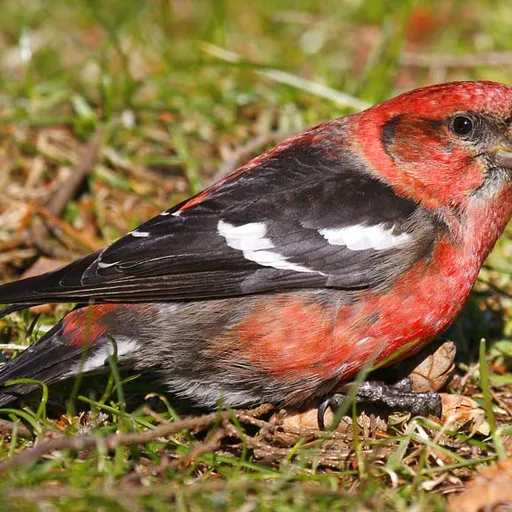
Two-barred Crossbill
Loxia leucoptera
Least Concern
Listen
XC613110 · Doug Hynes · Pouch Cove Line, Newfoundland and Labrador, Canada · CC BY-SA 4.0
Overview
The two-barred crossbill, also known as the white-winged crossbill (Loxia leucoptera), is a small passerine bird in the finch family. It breeds in coniferous forests across North America and the Palearctic and is currently classified as Least Concern on the IUCN Red List.
Identification
- Length ranges from 14.5–17 cm with a weight of 25–40 g, featuring short legs and a forked tail.
- Possesses a crossed bill and two prominent white wing-bars, with white tips on the tertials.
- Adult males have bright raspberry-red foreheads, crowns, napes, and upper-parts with blackish scapulars edged in pink, while females are greenish-yellow.
- Easier to identify in North America than other crossbills, though the main confusion remains with the red crossbill, particularly regarding white wingbars.
Habitat
This species inhabits coniferous forests in Alaska, Canada, the northernmost United States, and across the Palearctic into northeast Europe. It is mainly resident but may irrupt south if food sources fail, and forms mixed flocks outside the breeding season.
Diet
Specialist feeders on conifer cones, the bird uses its unusual crossed bill to extract seeds. There is a strong preference for larch, along with rowan berries, and in North America, also eastern hemlock and white spruce cones.
Did you know?
The specific epithet leucoptera is derived from Ancient Greek words meaning 'white-winged', referencing the two prominent white wing-bars that give the bird its name.
Sources
- Wikipedia · CC BY-SA 4.0
- Wikidata · CC0 1.0