
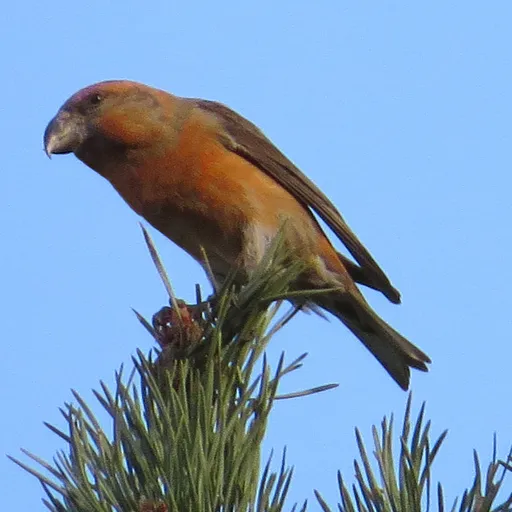
Parrot Crossbill
Loxia pytyopsittacus
Least Concern
Listen
XC664060 · Max Karlsson · Värmdö, Stockholms län, Sweden · CC BY-SA 4.0
Overview
The parrot crossbill (Loxia pytyopsittacus) is a small passerine bird in the finch family Fringillidae, breeding primarily in pine forests across northern and northeastern Europe. It is the largest of the crossbill species, distinguished by its heavier build and thicker bill, though it remains difficult to separate visually from its congeners.
Identification
- Size: Slightly larger and bulkier than other crossbills, measuring 16 to 18 cm in length with a wingspan of 27 to 31 cm.
- Plumage: Adult males are typically red or orange, while females are green or yellow, though plumage distinctions from red and Scottish crossbills are negligible.
- Bill: Features a thicker mandible with larger head and bill proportions; the crossed tips are often not readily apparent.
- Voice: Produces a deeper, harder 'choop' or 'tyuup' call, which is likely the most reliable field identification indicator.
Habitat
This species breeds in the pine forests of northwest Europe and western Russia, with a small population also present in Scotland. It is mainly resident but may migrate south or west if its specific food source fails.
Diet
A specialist feeder on conifer cones, particularly those of Scots pine, for which its unusual bill shape is an adaptation to assist in extracting seeds. Outside the breeding season, they form flocks often mixed with other crossbill species.
Did you know?
The specific epithet pytyopsittacus combines the words for 'pine' and 'parrot', reflecting the bird's primary diet and its somewhat parrot-like appearance. Its genus name Loxia derives from the Ancient Greek word for 'crosswise', referring to the mandibles that cross at their tips.
Sources
- Wikipedia · CC BY-SA 4.0
- Wikidata · CC0 1.0