
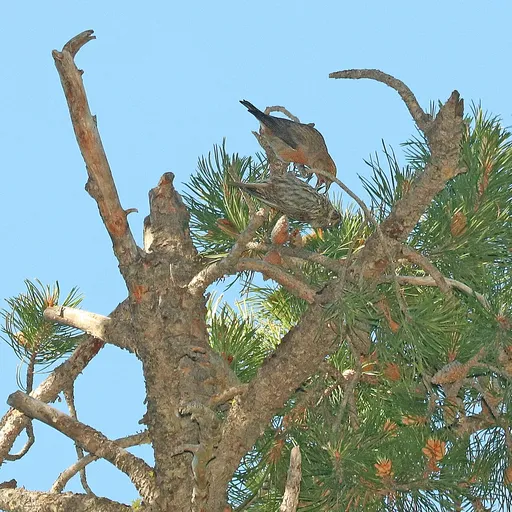
Cassia Crossbill
Loxia sinesciuris
Overview
The Cassia crossbill (Loxia sinesciuris) is a passerine bird that is endemic to the South Hills and Albion Mountains in southern Idaho. Originally described as a call type of the red crossbill in 2009, it was recognised as a distinct species in 2017 due to its phylogenetic distinctiveness and ecological isolation.
Identification
- Adult males display brick red plumage on the crown, breast, and belly, contrasting with brown flight feathers.
- Adult females possess an overall dull green or olive-yellow plumage with brown flight feathers.
- Features a deep and thick, crisscrossed bill adapted for cracking hard pine cones, with a body mass ranging from 29.2 to 43.9 g.
- Songs are more repetitive with fewer syllables than other crossbill call types, characterised by buzzy, strained chip and kip notes with silences between phrases.
Habitat
This species resides year-round in the forests of the South Hills and Albion Mountains in South Idaho, occupying a total area of approximately 67 km². It is almost exclusively found in mature and old-growth lodgepole pine-dominated forests that lack American red squirrels. Although records exist in California, Wyoming, and Colorado, these do not represent the core breeding habitat.
Diet
The Cassia crossbill forages exclusively on lodgepole pine cones within its specific geographic region. It uses its deep bill to pry open cones, relying on its tongue to extract seeds and a groove in its mouth to shell them. It primarily feeds on older, weathered cones where the scales have separated, as younger serotinous cones are too strongly bonded for its beak to open easily.
Did you know?
The species is involved in a coevolutionary arms race with the lodgepole pine, where the trees evolve thicker-scaled cones in response to the crossbills evolving deeper bills to access the seeds. The lack of American red squirrels, which are usually the primary seed dispersers for these trees, allows serotinous cones to accumulate in high quantities, supporting the crossbill population.