
Palila
Loxioides bailleui
Critically Endangered
Overview
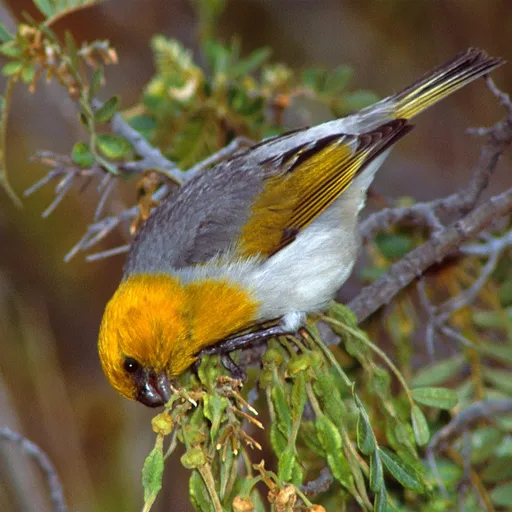
The palila, Loxioides bailleui, is a critically endangered finch-billed Hawaiian honeycreeper. It possesses a heavy, dark bill and is one of the largest living members of its family.
Identification
- Plumage: Golden-yellow head and breast, white to light grey ventral plumage, medium grey back, and olive-green wings and tail.
- Size: Measures 15–19 cm in length and is considered the heaviest Hawaiian honeycreeper, averaging 38.1 g for males and 37.6 g for females.
- Bill: Heavy, dark bill with swollen sides, specialised for opening Fabales pods.
- Song: Features a characteristic, clear, bell-like whistle described as 'chee-clee-o' or 'te-cleet' during foraging.
Habitat
Currently restricted to the upper slopes of Mauna Kea on the island of Hawaiʻi, between 2,000 and 2,900 m above sea level. The species favours a dry forest habitat mix of māmane and māmane-naio trees, with population density increasing where māmane grows plentifully.
Diet
The diet consists almost exclusively of immature māmane seeds, which contain high levels of quinolizidine alkaloids that would kill other small animals. Palila manipulate these Fabales pods with their feet and bills to extract the embryos, while also consuming naio berries, flowers, and caterpillars such as the māmane codling moth.
Did you know?
Nestlings are fed primarily on Cydia caterpillars because the larvae sequester the māmane toxins from their own food, rendering the insects non-toxic and safe for the young birds that cannot yet process the poison.
Sources
- Wikipedia · CC BY-SA 4.0
- Wikidata · CC0 1.0