
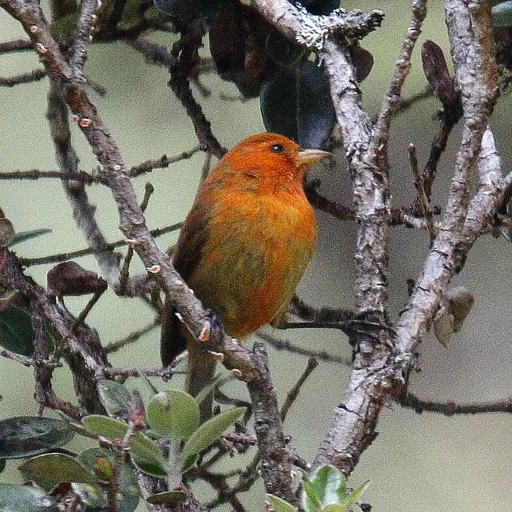
Hawaii Akepa
Loxops coccineus
Endangered
Overview
The Hawaiʻi ʻākepa (Loxops coccineus) is an endangered honeycreeper native to the Hawaiian Islands, classified as such by the IUCN Red List. It was first documented by western science during Captain James Cook's third voyage and was split from other ʻākepa species in 2015.
Identification
- Plumage: Females are a dusty green colour, whereas males are bright orange.
- Size: Approximately 10 cm (four inches) in length.
- Bill: Features a small, crossed bill characteristic of the Loxops genus.
- Song: Produces a slight quivering whistle that ends with a long trill.
Habitat
The species survives exclusively on the island of Hawaiʻi, restricted to two or three high-elevation locations including Hakalau Forest National Wildlife Refuge and the upper forest areas of Kaʻū. They inhabit old-growth ʻōhiʻa and koa forests above 1,200 metres, where avian malaria and pox are less prevalent.
Diet
This bird feeds on spiders and other invertebrates, supplemented by the nectar of flowers such as ʻōhiʻa, naio, and lobelia.
Did you know?
The Hawaiʻi ʻākepa is the only obligate cavity-nester in Hawaiʻi, relying entirely on naturally occurring holes in large, old trees because no native island species is capable of excavating nest cavities of sufficient size.
Sources
- Wikipedia · CC BY-SA 4.0
- Wikidata · CC0 1.0