
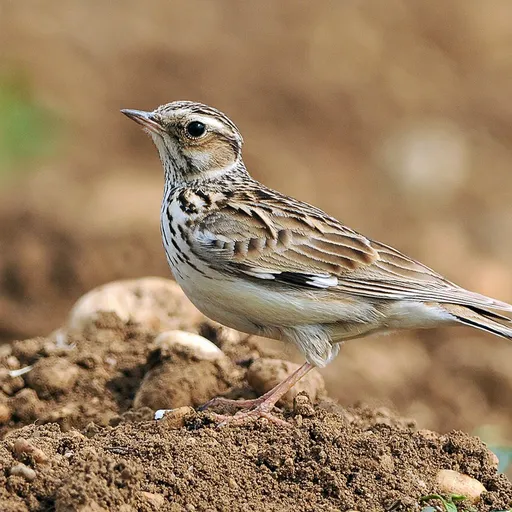
Woodlark
Lullula arborea
Least Concern
Listen
XC914816 · Sonothèque ADVL · Cabane Vauban (Carolles), Manche, Normandie, France · CC0 1.0
Overview
The woodlark is the only extant species in the lark genus Lullula and a passerine bird found across most of Europe, the Middle East, western Asia, and the mountains of northern Africa. While populations in the west of its range are mainly resident, those in the east tend to be migratory, moving further south during the winter months.
Identification
- Primarily brown above with a pale underside and a distinctive white superciliar meeting on the nape.
- A comparatively small bird measuring 13.5 to 15 centimetres long, roughly 20% shorter than the skylark.
- Features a white-tipped tail and short, broad wings, but lacks the white edging on the tail sides and wing rear edges seen in skylarks.
- Produces a melodious, warbling song described as a serial 'lū-lū-lū-lū-lū' or 'toolooeet toolooeet'.
Habitat
The species inhabits heathland and open spaces sparsely populated with trees, with a preference for clearings in pine forests and newly planted areas with pine saplings. Its range extends from England in the west to Iran and Turkmenistan in the east, and from the Scandinavian Peninsula in the north to parts of northern Egypt in the south. Although mainly resident in the western part of its range, the bird has also been recorded more rarely in urban areas.
Diet
The woodlark is primarily vegetarian as an adult, with a diet composed mostly of seeds. During the breeding season, it also consumes medium-sized insects such as beetles, flies, and moths.
Did you know?
The scientific name Lullula is onomatopoeic, derived from the French 'Lulu'—the name given to the bird by de Buffon—reflecting the sound of its song.
Sources
- Wikipedia · CC BY-SA 4.0
- Wikidata · CC0 1.0