
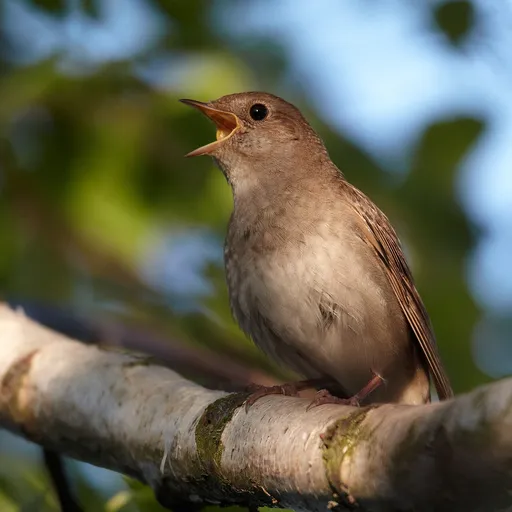
Thrush Nightingale
Luscinia luscinia
Least Concern
Listen
XC1105587 · Kevin Guille · Birky, Lyubeshivs'kyi district, Volyn Oblast, Ukraine · CC0 1.0
Overview
The thrush nightingale, also known as the sprosser, is a small passerine bird belonging to the Old World flycatcher family. It is a migratory species that breeds in forests across Europe and the Palearctic region before overwintering in Africa. The species is classified as Least Concern on the IUCN Red List.
Identification
- Approximately 16 cm long with a wingspan of about 18 cm, featuring a dark brown upper body with a slight olive tinge and a mottled, cloudy appearance on the underparts.
- Distinctive lack of rufous tail side patches, which helps differentiate it from the very similar common nightingale.
- Loud male song characterized by whistles, trills, and a flute-like 'pioo' with a solemn quality, lacking the loud whistling crescendo of the common nightingale.
- Brown bill, legs, and feet with dark brown irises.
Habitat
Breeds in damp deciduous woodland, typically with alder and birch, favouring thick undergrowth, brambles, and tangled vegetation near water. The range extends from Denmark and Scandinavia across eastern Europe and western temperate Asia, with the bird overwintering in Africa south of the Sahara. It is an occasional visitor to the British Isles.
Diet
Primarily an insectivore that feeds on the ground, consuming earthworms, spiders, and various insect stages such as beetles, small moths, ants, and flies. In autumn, it supplements its diet with berries from currants and elders. Before migrating across the Sahara, the bird builds up fat reserves, a process potentially stimulated by magnetic cues.
Did you know?
Experimental evidence suggests that magnetic cues may trigger the bird to build up fat reserves before its southward migration across the Sahara. A simulation of the magnetic field found in northern Egypt was observed to encourage birds preparing to migrate from Sweden to increase their body fat.
Sources
- Wikipedia · CC BY-SA 4.0
- Wikidata · CC0 1.0