
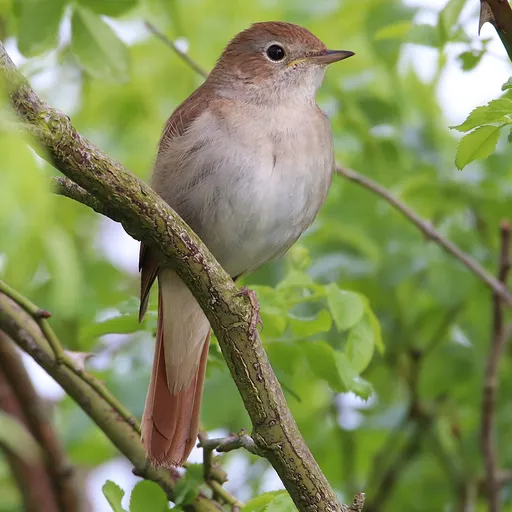
Common Nightingale
Luscinia megarhynchos
Least Concern
Listen
XC818342 · Sonothèque ADVL · Camping La Baie du Mont Saint Michel (Céaux), Manche, Normandie, France · CC0 1.0
Overview
The common nightingale, or Luscinia megarhynchos, is a small passerine bird classified as an Old World flycatcher within the group known as chats. It is celebrated for its powerful and beautiful song, which is often described as one of the most beautiful sounds in nature.
Identification
- A small bird, slightly larger than a European robin, measuring 15–16.5 cm in length.
- Plain brown upperparts with a reddish tail, and buff to white underparts; sexes appear similar, though eastern and Caucasian subspecies show a stronger face pattern with a pale supercilium.
- Produces a loud song featuring an impressive range of whistles, trills, and gurgles, with a characteristic loud whistling crescendo.
- Generally elusive and secretive, often remaining motionless in dense shrubs to avoid detection.
Habitat
This migratory species breeds in forest and scrub across Europe and the Palearctic, nesting on or near the ground in dense vegetation without a closed canopy. It winters in Sub-Saharan Africa and is absent from the Americas. In the UK, it is found at the northern limit of its range, primarily in South East England and East Anglia.
Diet
The common nightingale is an insectivorous species.
Did you know?
Common nightingales possess an extraordinarily large song repertoire, averaging 190 distinct song types with exceptional males exceeding 300, and a syllable repertoire of approximately 1,160. They can sing continuously for seven to eight hours without major breaks, typically from concealed perches to attract mates.
Sources
- Wikipedia · CC BY-SA 4.0
- Wikidata · CC0 1.0