
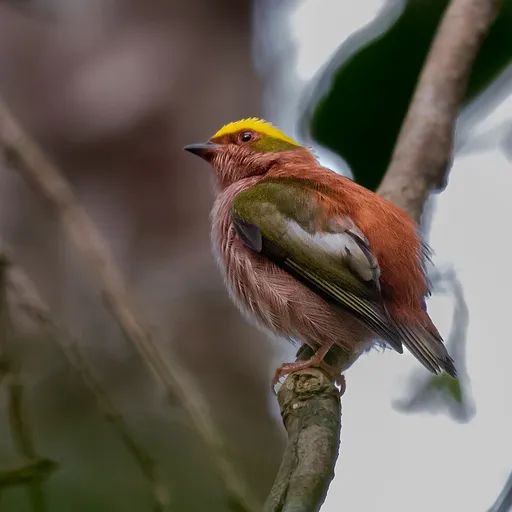
Fiery-capped Manakin
Machaeropterus pyrocephalus
Least Concern
Overview
The fiery-capped manakin (Machaeropterus pyrocephalus) is a small, sexually dimorphic bird in the family Pipridae. It is found across parts of South America, including Bolivia, Brazil, Colombia, Peru, and Venezuela, and is currently assessed as Least Concern on the IUCN Red List.
Identification
- Males of the nominate subspecies feature a golden crown and nape with a central red stripe, rosy rufous to maroon upperparts, and olive wings with white inner secondaries and black tertial spots.
- Females have olive upperparts, a pale grayish throat, and dull pale olive underparts with blurry streaking and a yellowish tinge on the belly.
- Measuring 8 to 9 cm in length and weighing approximately 10 g, both sexes possess a dark red iris, a blackish bill with a paler base, and pinkish to purplish-cream legs.
- The male's advertising call is described as a high-pitched, bell-like or frog-like pling, accompanied by a loud 'zssssss' sound from wing movements during display.
Habitat
The species inhabits the interior and edges of humid primary and secondary forest and woodland. Its elevation range varies by region, typically between 100 and 200 m in Venezuela, and up to 1,100 m, or locally 1,200 m, in Peru.
Diet
This manakin feeds on small fruits, with a preference for those of the Melastomataceae family, which it typically plucks while perched. It also consumes small insects, usually capturing them in mid-air.
Did you know?
During its courtship display, the male hangs head-down from a branch and twists back and forth very quickly, producing a loud 'zssssss' sound with its wings. This display occurs at an 'exploded' lek, a gathering area where multiple males exhibit simultaneously.
Sources
- Wikipedia · CC BY-SA 4.0
- Wikidata · CC0 1.0