
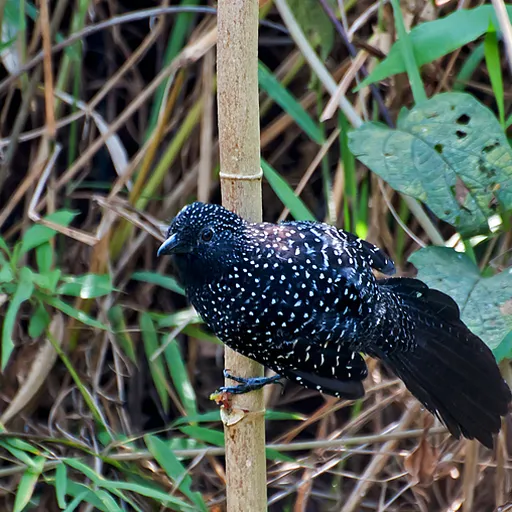
Large-tailed Antshrike
Mackenziaena leachii
Least Concern
Overview
The large-tailed antshrike, Mackenziaena leachii, is a species of bird in the family Thamnophilidae, commonly known as the typical antbirds. It is found in the Atlantic Forest regions of Argentina, Brazil, Paraguay, and Uruguay.
Identification
- A large, dark antbird measuring 25 to 26 cm in length with a long, full tail.
- Features a moderately long black bill with a distinct hook at the end.
- Adult males are mostly black with small white spots on the crown, nape, upperparts, and sides, while adult females are brownish-black with a rufous forehead and pale buff bars on the wings.
- Song consists of a hurried, slightly slowing series of about 15 high, strident 'sweep' notes that rise then descend, accompanied by a sharp 'sreee' call.
Habitat
Inhabits the dense understorey of the Atlantic Forest, ranging from humid foothill and montane forests in the north to degraded scrub, dry forest, and thickets in the south. It occurs from sea level to approximately 2,200 m, favouring higher elevations in the northern part of its range, particularly in areas with large stands of bamboo.
Diet
Feeds on a variety of large insects, other arthropods, molluscs, and small vertebrates such as frogs, lizards, snakes, bird eggs, and nestlings. Forages singly or in pairs within about 5 m of the ground in dense bamboo and shrubs, hopping from branch to branch and reaching to glean prey or dropping to the ground to seize it.
Did you know?
Due to its preference for the dense understorey, this species is more often heard than seen.
Sources
- Wikipedia · CC BY-SA 4.0
- Wikidata · CC0 1.0