
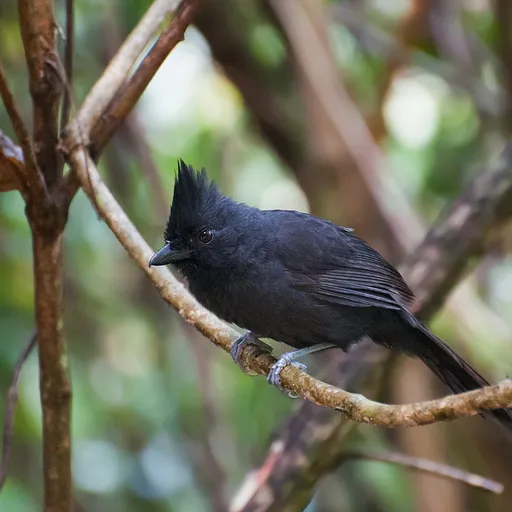
Tufted Antshrike
Mackenziaena severa
Least Concern
Overview
The tufted antshrike (Mackenziaena severa) is a large, dark antbird in the family Thamnophilidae. It inhabits the Atlantic Forest regions of Argentina, Brazil, and Paraguay and is currently classified as Least Concern by the IUCN.
Identification
- Measures 20 to 23 cm in length and weighs between 50 and 80 g, featuring a moderately long black bill with a distinct hook at the end similar to true shrikes.
- Exhibits significant sexual dimorphism; adult males are mostly sooty gray with blackish foreheads and crests, while females are blackish brown with rufous foreheads and cinnamon bars on their upperparts.
- Both sexes possess red irises and a usually flattened crest.
- Song consists of a short, slow, slightly accelerating series of 6–8 very high, rising, strident 'sreek' notes, accompanied by a sudden rising 'sreeew' call.
Habitat
Found in the Atlantic Forest across southeastern Brazil, eastern Paraguay, and northeastern Argentina, this species resides in the understorey to mid-storey of evergreen and secondary forests in lowlands and foothills. It favours areas with dense tangles of vines, thickets, and bamboo, and can be found in degraded forests and overgrown plantations up to 1,400 m in elevation.
Diet
Feeds on a variety of large insects, other arthropods, molluscs, and small vertebrates such as frogs, lizards, snakes, bird eggs, and nestlings. It forages singly or in pairs, typically within 3 m of the ground but reaching up to 10 m in dense vegetation, by hopping from branch to branch or along the ground to glean prey.
Did you know?
Its eggs are described as having a clear base color adorned with dark lilac spots and gray lines, though little else is known about the species' breeding biology.
Sources
- Wikipedia · CC BY-SA 4.0
- Wikidata · CC0 1.0