
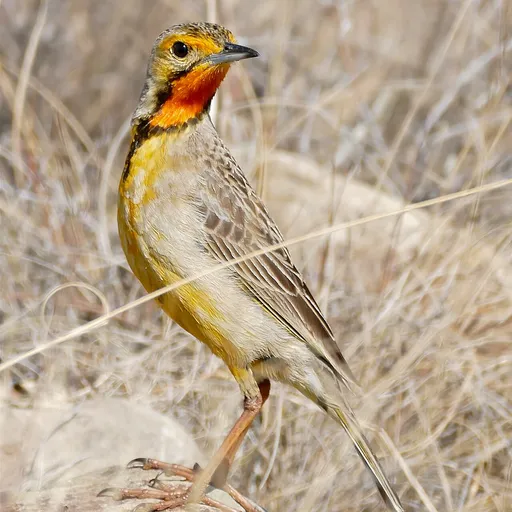
Cape Longclaw
Macronyx capensis
Least Concern
Overview
The Cape longclaw, also known as the orange-throated longclaw, is a passerine bird in the family Motacillidae found in Southern Africa. It is currently assessed as Least Concern on the IUCN Red List.
Identification
- Adult males possess a grey head with a buff supercilium, a streaked blackish back, and a bright orange gorget with a distinct black breast band.
- Females are duller, featuring a yellow throat and a much weaker breast band, while juveniles have dirty yellow throats and yellowish-white underparts.
- The species is 19–20 cm long and often stands upright on stones, anthills, or large grass clumps with its breast extended.
- Song consists of a musical cheewit cheewit, accompanied by a tsweet contact call and a mewling alarm call.
Habitat
This species occurs in Zimbabwe and southern and eastern South Africa, inhabiting coastal and mountain grassland, often in close proximity to water sources.
Diet
The Cape longclaw feeds on the ground on a diet consisting of insects and some seeds.
Did you know?
This bird exhibits a striking resemblance to the unrelated icterid meadowlarks of the Americas, a phenomenon presumably resulting from convergent evolution.
Sources
- Wikipedia · CC BY-SA 4.0
- Wikidata · CC0 1.0