
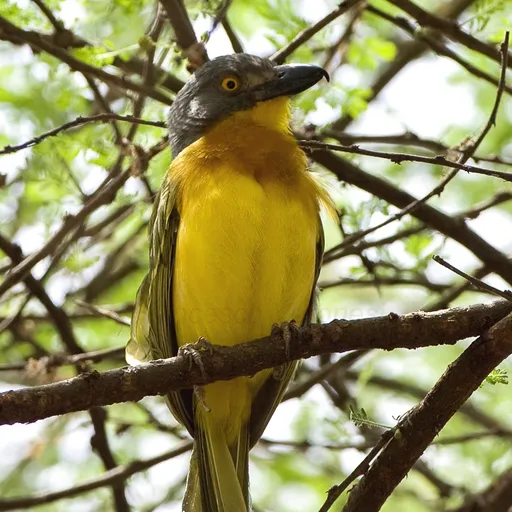
Grey-headed Bushshrike
Malaconotus blanchoti
Least Concern
Overview
The grey-headed bushshrike, scientifically known as Malaconotus blanchoti, is a widespread passerine bird in the family Malaconotidae, colloquially referred to as the ghostbird. It is the most widespread species of its genus, characterised by large bushshrike traits such as massive bills and mournful hooting calls. The species is classified as Least Concern by the IUCN Red List.
Identification
- Measures 22.6 to 25.2 cm from bill to tail with formidable black bills and rich yellow irises that create a distinctive appearance.
- Immature birds are generally paler, while juveniles possess pale yellow chest plumage, brown barring or mottling on the crown, brown eyes, and brownish horn bills.
- The male produces a famous uncanny, mechanical-sounding series of hooting notes that can last for an hour or more, often preceded by cluck or tic sounds.
- Sexes are alike in plumage, though the species may be confused with the smaller orange-breasted bushshrike, which has more gracile features.
Habitat
The bird inhabits a range of wooded environments, typically preferring denser vegetation within dry or moist savannahs, such as miombo woodland, riparian vegetation, and tall Acacia trees. Its distribution covers sub-Saharan Africa, though it is relatively absent from Central Africa and the interior of southern Africa, where it is often replaced by the orange-breasted bushshrike. It avoids areas with annual rainfall below 500 mm and is occasionally found in gardens, where it may be overlooked if not for its frequent calling.
Diet
The diet consists primarily of insects, but the bird also preys on mice, which are swallowed whole, as well as small birds, snakes, lizards, and chameleons. Males cease their prolonged vocalising sessions once the female begins incubating eggs, at which point they start providing her with food items.
Did you know?
The nest, which is completed in just 10 days, is often constructed in the upper stratum of a tree so well-hidden in foliage or mistletoes that it resembles the nest of a small raptor. The species is sometimes found living in close proximity to several other bushshrike species, including its closest relative, the orange-breasted bushshrike.
Sources
- Wikipedia · CC BY-SA 4.0
- Wikidata · CC0 1.0