
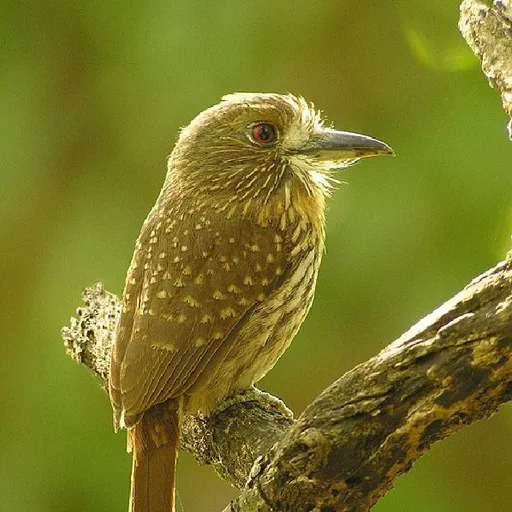
White-whiskered Puffbird
Malacoptila panamensis
Least Concern
Listen
XC251074 · Niels Krabbe · Esmeraldas: Canandé, Ecuador · CC BY-SA 4.0
Overview
The white-whiskered puffbird (Malacoptila panamensis), also known as the white-whiskered soft-wing or brown puffbird, is a near-passerine bird in the family Bucconidae. It is classified as Least Concern on the IUCN Red List, though its population is believed to be decreasing.
Identification
- Approximately 18 cm (7.1 in) long with an average weight of 43 g (1.5 oz).
- Large bill featuring bristles around the base and distinctive white 'whiskers', which are actually tufts of feathers.
- Plumage varies by sex; adult males are brown to chestnut brown with tawny markings, while females are grayer and olive to brown with buff underparts.
- Song is described as a high-pitched descending trill, often ending with an emphasized note, while a common call is a high, thin, reedy 'tsssiiiw' that fades away.
Habitat
Found in southeastern Mexico, Central America (excluding El Salvador), Colombia, Ecuador, and Peru, this species primarily inhabits dense primary evergreen forest, though it also occupies secondary forest and field edges. It typically forages within 6 m of the ground and ranges in elevation from sea level to 1,200 m depending on the location.
Diet
Employing a watch-and-wait technique, the bird sits motionless before dashing to capture large invertebrates, small frogs, and lizards, which it beats against a perch before eating. It has also been observed following army ant swarms and joining mixed-species foraging flocks.
Did you know?
The female lays only two glossy white eggs, rarely three, in a cavity at the end of a burrow dug into gently sloping ground.
Sources
- Wikipedia · CC BY-SA 4.0
- Wikidata · CC0 1.0