
Crescent-chested Puffbird
Malacoptila striata
Least Concern
Overview
The crescent-chested puffbird (Malacoptila striata) is a near-passerine bird in the family Bucconidae, endemic to Brazil. It is assessed as Least Concern by the IUCN, although the lesser crescent-chested puffbird (Malacoptila minor), treated as a separate species by some authorities, is classified as Endangered due to increasing deforestation.
Identification
- Measures 17.5 to 20 cm in length, with the nominate subspecies weighing between 40 and 47 g.
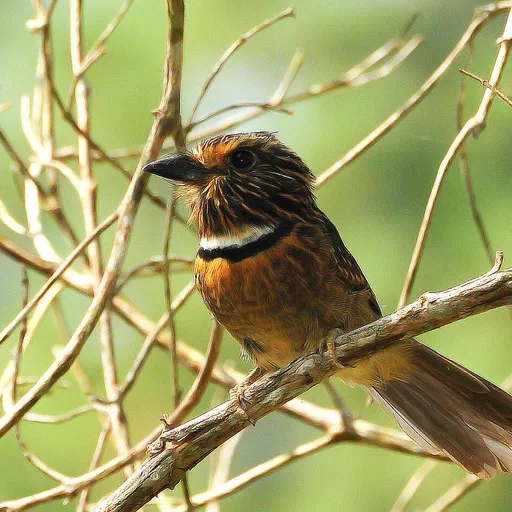
- The head and upperparts are blackish with buffy streaks, while the face is rufous around the bill with a buffy or white 'moustache'.
- The upper breast features a distinctive white crescent with a black band below it, and the lower breast is rufous.
- The song consists of a high-pitched whistle of more than 10 notes, described as 'bieh, bieh, bieh…', while the alarm call is a high, thin, descending 'seeee...'.
Habitat
This species inhabits semi-open landscapes, including the edges of humid lowland forest, logged forest, and secondary forest. It frequently occurs along roads and at the edges of clearings but rarely in the forest interior. Its elevation range spans from sea level to 2,100 m, with the nominate subspecies found in southeastern Brazil and the minor subspecies in the northeast.
Diet
The crescent-chested puffbird is a mostly solitary forager, though it has been observed following army ant swarms alongside other birds. Its diet is not well documented but is believed to consist primarily of invertebrates.
Did you know?
Nests have been found in burrows excavated in earthen banks, though details regarding breeding phenology, the nest structure, and eggs remain largely unknown.
Sources
- Wikipedia · CC BY-SA 4.0
- Wikidata · CC0 1.0