
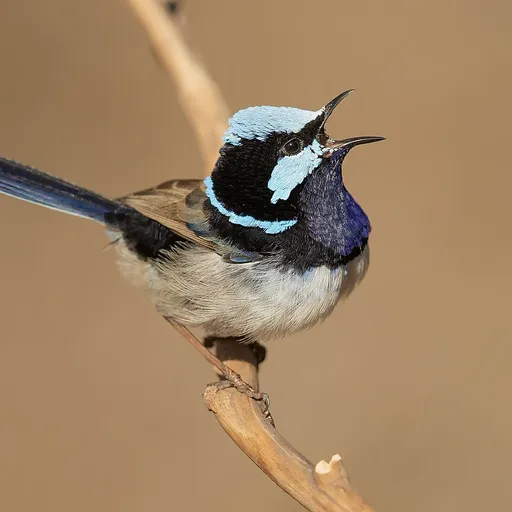
Superb Fairywren
Malurus cyaneus
Least Concern
Overview
The superb fairywren (Malurus cyaneus) is a common passerine bird in the family Maluridae, native to the south-eastern corner of Australia. It is a sedentary and territorial species that exhibits high sexual dimorphism and is well-adapted to urban environments.
Identification
- Breeding males display brilliant iridescent blue on the forehead, ear coverts, mantle, and tail, contrasting with a black mask, throat, breast, and bill.
- Females, immatures, and non-breeding males are plain fawn or grey-brown with a lighter underbelly; non-breeding males may have a dull greyish-blue tail.
- The species is approximately 14 cm long and weighs 8–13 g, with a relatively long, narrow, and pointed bill.
- Movement consists of jaunty hops and bounces, with the tail usually held upright to assist balance.
Habitat
The species is common throughout the wet and fertile south-eastern corner of Australia, ranging from south-eastern South Australia and the tip of the Eyre Peninsula through Victoria, Tasmania, and into New South Wales and Queensland. It inhabits areas with dense undergrowth, including grasslands, woodlands, heaths, and suburban gardens, but avoids dense forests, alpine environments, and forestry plantations that lack undergrowth.
Diet
Superb fairywrens eat mostly insects and supplement their diet with seeds. They are active and restless feeders, foraging on open ground near shelter and through lower foliage using a series of hops and bounces.
Did you know?
Males pluck yellow petals and display them to females as part of their courtship, a behaviour that can occur even outside the breeding season. The species is socially monogamous but sexually promiscuous, meaning pair-bonded birds will mate with others and help raise unrelated young.
Sources
- Wikipedia · CC BY-SA 4.0
- Wikidata · CC0 1.0