
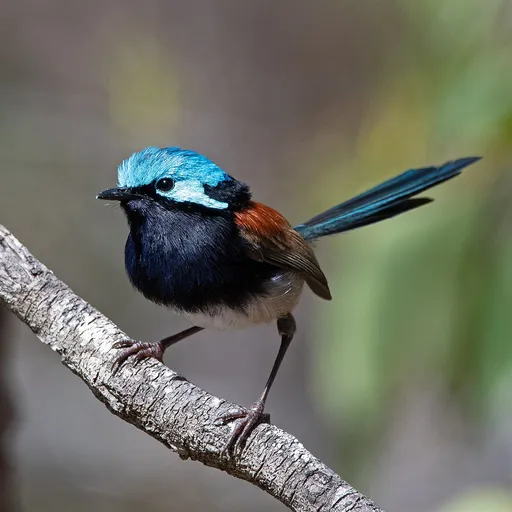
Red-winged Fairywren
Malurus elegans
Least Concern
Overview
The red-winged fairywren (Malurus elegans) is a non-migratory passerine bird endemic to the southwestern corner of Western Australia. As the largest of the fairywrens, it is characterised by marked sexual dimorphism, with males displaying brilliant breeding plumage while females and juveniles are predominantly grey-brown.
Identification
- Males in breeding plumage feature an iridescent silvery-blue crown, ear coverts, and upper back, with bright red-brown shoulders, a black throat, and grey-brown wings and tail.
- Females, non-breeding males, and juveniles are predominantly grey-brown; adult males retain a black bill and lores, while females have rufous lores and a pale grey eye-ring.
- At 15 cm long and weighing 8–11 g, it is the largest of the fairywrens, with a proportionally large tail often held upright.
- Vocalisations include a high-pitched 'type one' reel for territorial disputes, soft 'see-see-see' descending tones for contact, and a sharp 'tsit' as an alarm call.
Habitat
Restricted to the wetter southwestern corner of Western Australia, ranging from Moore River south to the Margaret River region and east to Albany. It inhabits the understorey of karri and jarrah forests, particularly preferring wet gullies and riverside sword sedge, while generally avoiding older forests and pine plantations.
Diet
Primarily insectivorous, this active forager probes bracken, low shrubs, and leaf-litter for insects, spiders, and caterpillars, occasionally ascending trees to feed on arthropods in eucalypt bark. Foraging patterns shift seasonally, with ants constituting a high proportion of the diet during winter when food is harder to find.
Did you know?
Male fairywrens pluck yellow petals to display to females during courtship, and the species supports the largest average group size among studied fairywrens, often comprising up to nine members including helper birds that assist in raising the young.
Sources
- Wikipedia · CC BY-SA 4.0
- Wikidata · CC0 1.0