
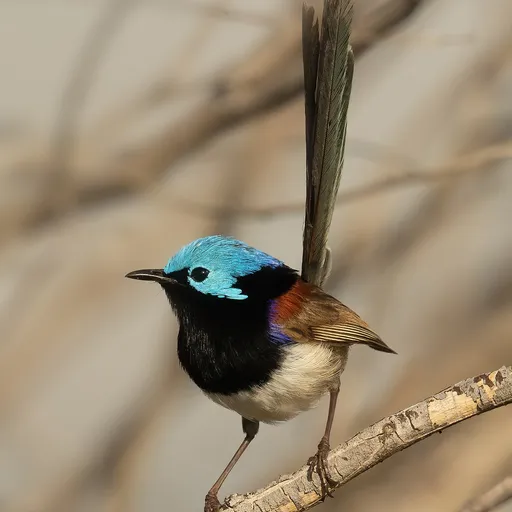
Variegated Fairywren
Malurus lamberti
Least Concern
Overview
The variegated fairywren, Malurus lamberti, is a small, sexually dimorphic bird native to eastern Australia. It is a cooperative breeding species that lives in small groups within dense scrubby vegetation east of the Great Dividing Range.
Identification
- Breeding males display brilliant iridescent blue ear coverts and crown, black throat, royal blue upper back, chestnut shoulders, and a creamy white belly.
- Non-breeding males, females, and juveniles are predominantly grey-brown, though some female subspecies are blue-grey; all males possess a black bill, while females have a red-brown bill and bright rufous lores.
- The basic song is a soft, high-pitched reel of short elements lasting 1-4 seconds, which is the softest among all malurids.
- Adults measure 14-15 cm in length and weigh between 6-11 g.
Habitat
This species inhabits scrubland with dense vegetation cover, often sheltering in mammal burrows to avoid extreme heat. Its range is confined to areas east of the Great Dividing Range, including suburban Sydney, where it prefers areas of higher plant diversity over mere density. Forestry plantations are generally unsuitable as they lack the necessary undergrowth.
Diet
Primarily insectivorous, the bird feeds on a wide range of small creatures including ants, grasshoppers, bugs, flies, weevils, and various larvae. Foraging mostly occurs deep inside shrubby vegetation less than 2 m above the ground, though active foraging near shelter on open ground is also observed.
Did you know?
The striking blue plumage of breeding males is highly iridescent due to the flattened and twisted surface of the barbules, and it reflects ultraviolet light strongly, making it potentially more prominent to other fairywrens that can see into the ultraviolet spectrum.
Sources
- Wikipedia · CC BY-SA 4.0
- Wikidata · CC0 1.0