
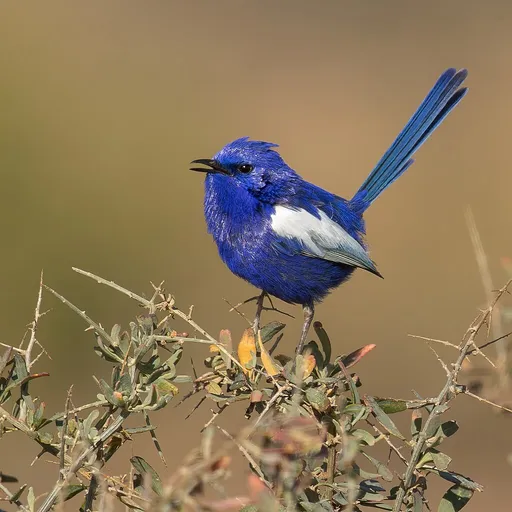
White-winged Fairywren
Malurus leucopterus
Least Concern
Listen
XC1069962 · Rob Nicholson · Mosquito Creek Road, Coolmunda, Goondiwindi Regional, Queensland, Australia · CC BY 4.0
Overview
The white-winged fairywren (Malurus leucopterus) is a small passerine bird in the family Maluridae, well adapted to dry environments in Central Australia. It is characterised by marked sexual dimorphism, with breeding males displaying vibrant cobalt blue or black plumage with contrasting white wings, while females are sandy-brown.
Identification
- Body length of 11 to 13.5 cm, with a relatively long, narrow, and pointed bill that is wider at the base.
- Breeding males possess a wholly cobalt blue or black body with white wings and shoulders, which are especially highlighted in flight and ground displays.
- Females are sandy-brown with a very light blue tail and a pinkish buff bill, distinguishing them from the brightly coloured males.
- Both sexes have long, slender tails held at an upward angle, featuring white fringes that disappear with wear.
Habitat
Found in heathland and arid scrubland where low shrubs provide cover, the species occupies dry environments across Central Australia. Its range stretches from central Queensland and South Australia across to Western Australia, including coastal regions and the Nullarbor. The species also has isolated populations on Dirk Hartog Island and Barrow Island off the western coast of Australia.
Diet
The white-winged fairywren mainly eats insects, supplementing this diet with small fruits and leaf buds. It forages by probing for or picking insects off its surroundings, utilising its fine and pointed bill to navigate its environment.
Did you know?
The blue plumage of breeding males reflects ultraviolet light strongly, making it potentially even more prominent to other fairywrens whose colour vision extends into this spectrum.
Sources
- Wikipedia · CC BY-SA 4.0
- Wikidata · CC0 1.0