
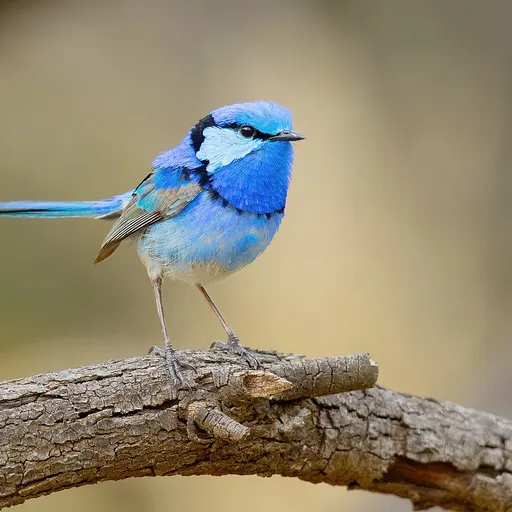
Splendid Fairywren
Malurus splendens
Least Concern
Overview
The splendid fairywren is a small, long-tailed passerine bird in the Australasian wren family, Maluridae. It is also known simply as the splendid wren or colloquially as the blue wren in Western Australia. The species is found across the arid and semiarid zones of the Australian continent.
Identification
- Breeding males are small and long-tailed, displaying bright blue and black colouration with a violet throat and deep blue back, wings, chest, and tail, while non-breeding males, females, and juveniles are predominantly grey-brown.
- The call is a gushing reel that is harsher and louder than other fairywrens, whereas a soft single trrt serves as a contact call within a foraging group.
- Breeding males exhibit a highly iridescent blue plumage, particularly on the ear coverts, which reflects ultraviolet light strongly, making it more prominent to other fairywrens whose colour vision extends into this spectrum.
Habitat
The splendid fairywren inhabits arid and semiarid regions across much of the Australian continent, from central-western New South Wales and southwestern Queensland over to coastal Western Australia. Its habitat typically includes dry and shrubby areas such as mulga and mallee in drier parts of the country, and forested areas in the southwest. The species has not adapted well to human occupation of the landscape and has disappeared from some urbanised areas, also lacking suitable undergrowth in forestry plantations of pine and eucalypts.
Diet
The splendid fairywren is predominantly insectivorous, feeding on a wide range of small creatures, mostly arthropods such as ants, grasshoppers, crickets, spiders, and bugs. This diet is supplemented by small quantities of seeds, flowers, and fruit, and they forage mostly on the ground or in shrubs less than two metres above the ground, a technique termed hop-searching. They may also occasionally forage in the canopy of flowering gums and rely on ants as an important last resort option when food is scarce in winter.
Did you know?
During the reproductive season, male splendid fairywrens pluck predominantly pink and purple petals and present them to females as part of a courtship display, a behaviour that might serve to strengthen the pair bond or allow extra males to gain matings with the female. The bird's blue plumage reflects ultraviolet light strongly, making it potentially even more prominent to other fairywrens than to human observers.
Sources
- Wikipedia · CC BY-SA 4.0
- Wikidata · CC0 1.0