
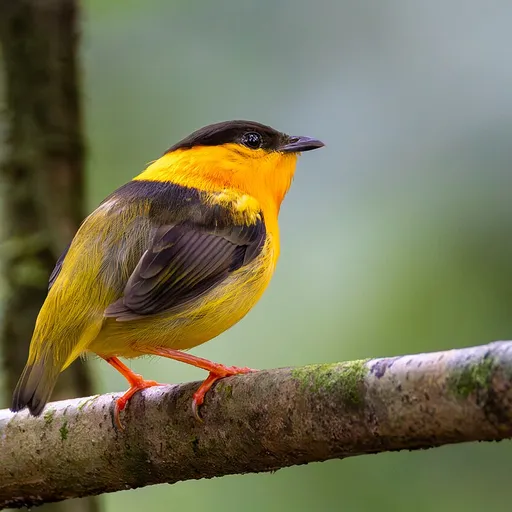
Orange-collared Manakin
Manacus aurantiacus
Least Concern
Overview
The orange-collared manakin (Manacus aurantiacus) is a small passerine bird endemic to the lowlands and foothills of the Pacific slope of Costa Rica and western Panama. It is a fairly common species with a restricted range, currently rated as least concern on the IUCN Red List.
Identification
- Small, plump and compact bird approximately 10 cm long with a heavy hooked bill and orange legs.
- Males display a striking pattern of black on the crown, wings, tail and mid-back, contrasting with orange on the head, neck, breast and upper back, and a bright yellow belly.
- Females and first-year males are olive-green with yellow underparts, lacking the male's bright orange plumage.
- Males produce a clear 'cheeuu' call and create loud wing snaps resembling breaking twigs during displays.
Habitat
Found in the lowlands and foothills of the Pacific slope up to 1100 m, this species inhabits semi-open moist forest, tall secondary growth, shady plantations and gardens. It is replaced on the Caribbean slopes by the white-collared manakin and eastwards by the golden-collared manakin.
Diet
The bird feeds low in the trees on fruit and some insects. Both food items are plucked from the foliage in flight.
Did you know?
At breeding time, males clear small patches of forest floor to bare earth and leap between thin upright sticks to create loud wing snaps, resembling breaking twigs, to attract females. When a female is present, males jump together, crossing each other above the bare display court while erecting their throat feathers into a beard.
Sources
- Wikipedia · CC BY-SA 4.0
- Wikidata · CC0 1.0