
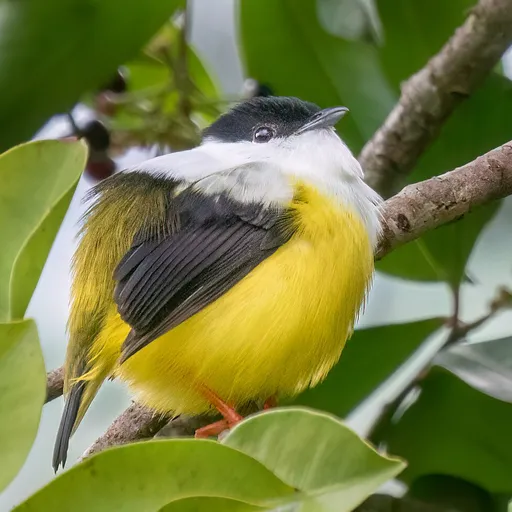
White-collared Manakin
Manacus candei
Least Concern
Overview
The white-collared manakin (Manacus candei) is a small, plump passerine bird native to the tropical New World. It is a fairly common species rated as 'least concern' by the IUCN due to its wide range and presumed large population.
Identification
- Size: Compact and short-tailed, approximately 11 cm long with a heavy hooked bill and orange legs.
- Male plumage: Features a black crown, wings, tail, and mid-back band, contrasting with a white head, neck, breast, and upper back; the rump is olive-green and the belly is bright yellow.
- Female and juvenile: Olive-green plumage with a yellow belly, resembling female orange-collared manakins.
- Vocalisation: The male call is a rolled preew, often accompanied by a loud snap like a breaking twig and rustling noises from modified wings.
Habitat
Found in the lowlands and foothills of the Caribbean slope up to 700 m elevation, ranging from southeastern Mexico to Costa Rica and the extreme west of Panama. It typically inhabits thickets at the edges of moist forest, tall secondary growth, and old cacao plantations.
Diet
This species feeds low in the trees on fruit and some insects. It forages by plucking food from the foliage in flight.
Did you know?
Males perform a spectacular courtship display where they leap between thin upright bare sticks to produce a loud wing snap, while erecting throat feathers to form a beard. The male's wings are heavily modified with narrow outer primaries and thickened, bowed inner primaries, a feature shared only with male orange-collared and golden-collared manakins.
Sources
- Wikipedia · CC BY-SA 4.0
- Wikidata · CC0 1.0