
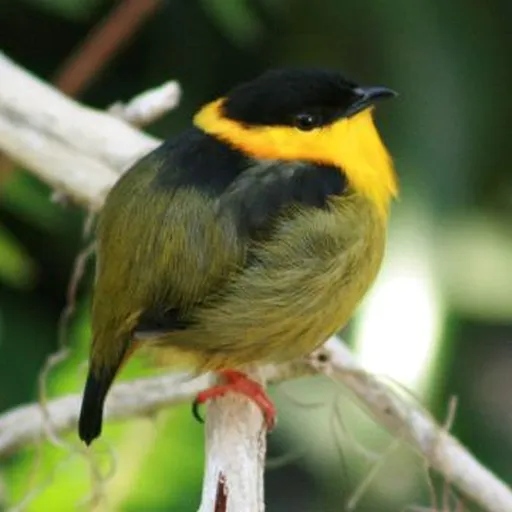
Golden-collared Manakin
Manacus vitellinus
Least Concern
Overview
The golden-collared manakin (Manacus vitellinus) is a small bird in the family Pipridae found in Colombia and Panama. It is classified as Least Concern by the IUCN and is considered one of the most abundant manakins across its range, with an estimated population of at least 500,000 mature individuals.
Identification
- Males of the nominate subspecies have a jet black crown, back, wings, and tail, contrasting with a deep, glossy golden-yellow chin, throat, and breast that wraps around the nape to form a distinctive collar.
- Adult females are mostly olive green with a paler yellow-olive wash on the lower breast and belly, and dusky wings and tail with olive edges.
- All subspecies possess a mouse brown to dark brown iris, a black bill, and variably bright orange to dull scarlet legs and feet.
- Adult males produce a loud, clear, two-parted whistle described as whee-you!, chee-poo, or chee-pooh, along with variable shorter whistles such as weeer or pee-you.
Habitat
This species inhabits evergreen and mature secondary forests in the lowlands and foothills of the tropical zone, ranging in elevation from sea level to 1,200 m. It tends to avoid the deep forest interior, preferring edges, watercourses, and regenerating clearings. Its distribution covers the Caribbean and Pacific slopes of Panama and various regions of Colombia, including the Western Andes.
Diet
The golden-collared manakin feeds primarily on a wide variety of small fruits, which it plucks while perched or with short sallies, supplemented by small numbers of insects. It typically forages within about 6 m of the ground but will ascend to the canopy of fruiting trees. Although it rarely joins mixed-species feeding flocks, it will loosely associate with other species in fruiting trees.
Did you know?
Females construct the nest alone as a shallow open cup of plant fibers, attaching it to a branch fork using spider web. While males perform elaborate acrobatic displays and vocalizations to court females, the females are solely responsible for incubating the clutch and provisioning the nestlings.
Sources
- Wikipedia · CC BY-SA 4.0
- Wikidata · CC0 1.0