
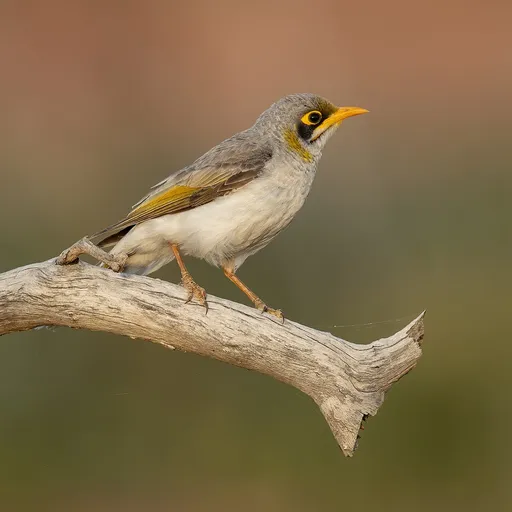
Yellow-throated Miner
Manorina flavigula
Least Concern
Overview
The yellow-throated miner (Manorina flavigula) is a medium-sized colonial honeyeater endemic to Australia. It is the most widely distributed species in the genus Manorina and is also known as the white-rumped miner.
Identification
- Medium-sized grey passerine with a total length of 22 to 28 cm and a weight between 50 and 61 g.
- Distinctive clean white rump that is easily visible in flight, distinguishing it from other miner species.
- Bright yellow beak, legs, and bare skin-patches around the eyes, accompanied by yellow highlighting on the throat, forehead, and chin.
- Higher-pitched calls than the noisy miner, though still recognisable as a miner call.
Habitat
Found across most of Australia, excluding the area east of the Great Dividing Range, Cape York Peninsula, and parts of the driest Central Australia. It inhabits open woodlands and scrublands, including acacia, eucalyptus, mallee, and casuarina, and readily adapts to disturbed habitats, regrowth, and roadsides.
Diet
Feeds on invertebrates, nectar, pollen, lerps, and seeds, with a ratio of insects to nectar varying between 65:35 and 70:30. Foraging is active and gregarious, typically occurring in the canopy or on the ground, and includes sally-stalling for insects on the wing.
Did you know?
Despite being aggressive towards smaller birds, yellow-throated miners have been observed sharing territory and nesting in close proximity to grey and pied butcherbirds, likely to benefit from mutual defence against predators.
Sources
- Wikipedia · CC BY-SA 4.0
- Wikidata · CC0 1.0