
Bell Miner
Manorina melanophrys
Least Concern
Overview
The bell miner, or bellbird (Manorina melanophrys), is a colonial honeyeater endemic to southeastern Australia. It belongs to the family Meliphagidae and is characterised by its highly organised social structure and specialised diet.
Identification
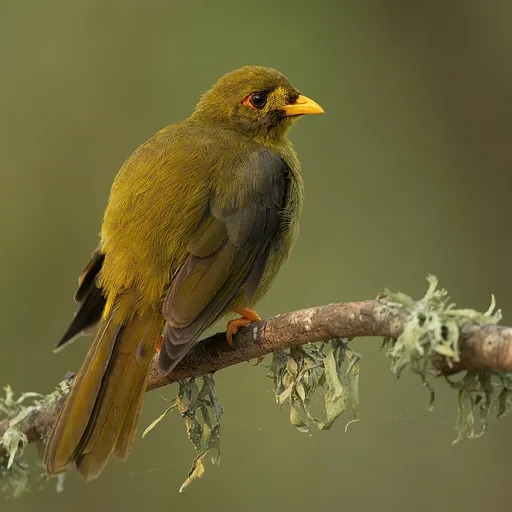
- Medium-sized honeyeater with olive-green plumage that is darker on the wings and yellower on the belly, blending effectively with the canopy.
- Features a slightly downturned yellow bill, bright orange legs, and a bare red-orange patch behind the eye.
- A dark streak runs from the corner of the bill downward, creating a slight frowning appearance, with black crowns and lores.
- Produces a distinctive tinkling, bell-like call that is heard more often than the bird is seen.
Habitat
Bell miners are distributed from around Gympie in Queensland south to Victoria, preferring the margins of wet or dry sclerophyll forest and thick woodlands, often near permanent water. They favour habitats with a dense understory but a sparse midstory and canopy, and are often found in areas that border but do not overlap with rainforest.
Diet
These birds feed almost exclusively on the dome-like coverings, known as lerps, and nymphs of certain psyllid bugs, which may constitute up to 90% of their diet. They forage primarily among leaves, branches, and loose bark in the canopy, generally at least 8 m in height, though they occasionally descend to the dense understory.
Did you know?
Bell miners are so closely associated with eucalyptus dieback that the phenomenon has been specifically named Bell Miner Associated Dieback (BMAD). There is a theory that the birds actively 'farm' psyllids by excluding competing insect-eating birds, allowing psyllid numbers to build up to levels that can eventually cause tree sickness.
Sources
- Wikipedia · CC BY-SA 4.0
- Wikidata · CC0 1.0