
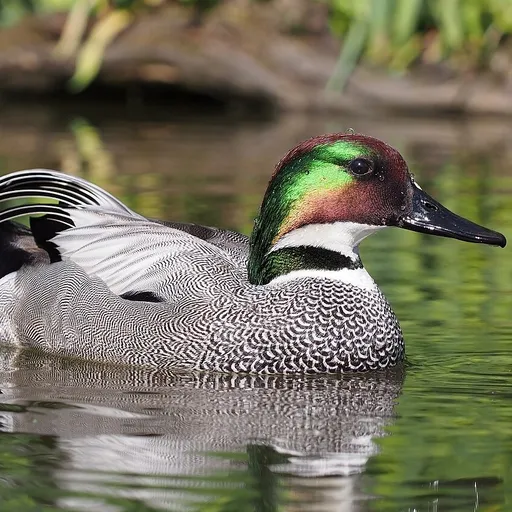
Falcated Duck
Mareca falcata
Least Concern
Overview
The falcated duck, or falcated teal (Mareca falcata), is a gadwall-sized dabbling duck from the east Palearctic. It is strongly migratory, breeding in eastern Asia and wintering in much of southeast Asia. The species is currently listed as Near Threatened on the IUCN Red List.
Identification
- The breeding male is unmistakable, with finely vermiculated grey body plumage, a dark green head and collar, and long sickle-shaped tertials hanging off its back.
- Females are dark brown with plumage resembling a female wigeon, aided by a long grey bill.
- Both sexes display a pale grey underwing in flight, with a blackish speculum bordered by a white bar on its inner edge.
- The male produces a shrill whistle described as 'tyu-tyu-vit…tyu-vit…tyu-tyu-vit' and a quiet whistle ending with a wavering 'uit-trr'.
Habitat
This species inhabits lowland wetlands such as water meadows and lakes, with breeding grounds spanning eastern Siberia, Mongolia, northeastern China, and northern Japan. During the non-breeding season, it winters in northern southeast Asia and northeastern India, forming large gregarious flocks. It requires coastal wetlands for survival and is sensitive to habitat loss through drainage and urbanisation.
Diet
Falcated ducks are primarily herbivorous, foraging by dabbling for plant food or grazing on leaves, seeds, grains, and nuts. They also consume small invertebrates, insects, larvae, crustaceans, and mollusks found near the water. Their diet is thought to assist in the dispersal of seeds over large areas.
Did you know?
Falcated ducks show a surprising amount of hybrid fertility with Eurasian wigeons, with hybrids observed in the wild performing courtship rituals closely related to the falcated duck while socially active in wigeon flocks. Genetic studies also indicate that ancient introgression around 14,000 years ago has resulted in a high frequency of falcated-like mitochondrial DNA in North American populations.
Sources
- Wikipedia · CC BY-SA 4.0
- Wikidata · CC0 1.0