
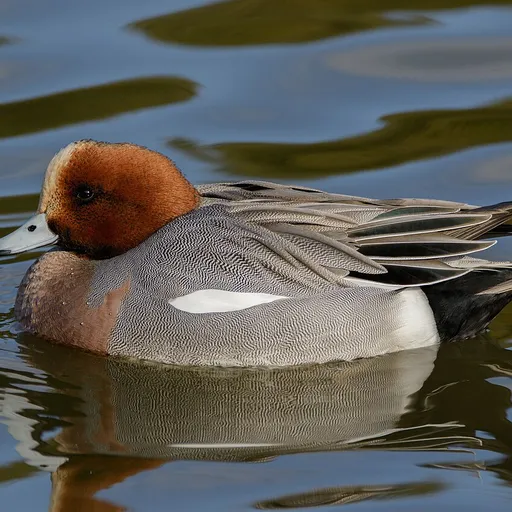
Eurasian Wigeon
Mareca penelope
Least Concern
Listen
XC782605 · Owen Camus · Arrondissement de la Rochelle (near Saint-Xandre), Charente-Maritime, Nouvelle-Aquitaine, France · CC0 1.0
Overview
The Eurasian wigeon (Mareca penelope) is a dabbling duck and one of three extant species in the genus Mareca. It is a common and widespread species throughout its Palearctic range, serving as the Old World counterpart to the North American wigeon.
Identification
- Breeding males feature a chestnut head with a creamy crown, a pink breast, grey flanks, and a distinct white patch on the upper wings.
- Females are light brown with plumage similar to the American wigeon but may appear with rufous or grey head morphs.
- This vocal species produces a distinctive male whistle transcribed as 'pjiew pjiew' and a low, growling female call sounding like 'rawr'.
Habitat
This species inhabits open wetlands, such as wet grasslands or marshes with some taller vegetation, and nests on the ground near water under cover. It breeds in the northernmost areas of Europe and the Palearctic but is strongly migratory, wintering further south in southern Asia and Africa. In Great Britain and Ireland, it is a common winter visitor but a scarce breeder.
Diet
The Eurasian wigeon feeds by dabbling for plant food or grazing, which it does very readily.
Did you know?
In the United States, this species will join flocks of the American wigeon and even hybridise with them. It was originally named Anas penelope by Linnaeus, referencing a Greek myth in which a duck saved Penelope when she was thrown into the sea.
Sources
- Wikipedia · CC BY-SA 4.0
- Wikidata · CC0 1.0