
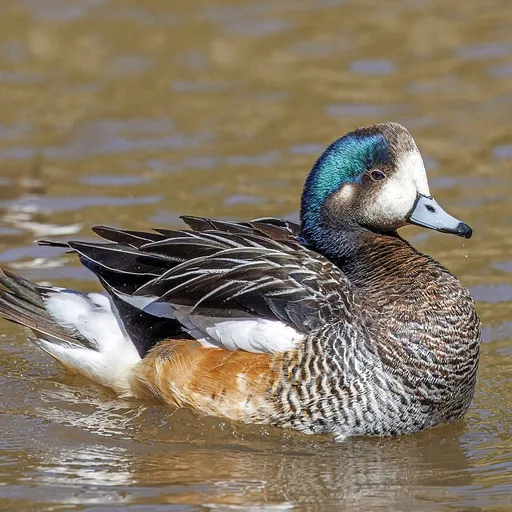
Chiloe Wigeon
Mareca sibilatrix
Least Concern
Overview
The Chiloé wigeon (Mareca sibilatrix), also known as the southern wigeon, is a dabbling duck indigenous to the southern part of South America. It is classified as Least Concern by the IUCN due to its wide distribution and stable wild population.
Identification
- Body length 46 to 56 cm with a wingspan of 75 to 86 cm.
- Iridescent green-blue cap on the head with a black neck and occipital region.
- Bluish gray bill with a black tip and gray legs and feet.
- White cheeks and forehead with a white auricular patch; breast barred black and white with rust-colored flanks in males and light brown in females.
Habitat
Found on freshwater lakes, marshes, shallow lagoons, and slow-flowing rivers in the southern part of South America. Breeding occurs primarily in Argentina, Uruguay, and Chile, with vagrants observed in South Georgia, South Orkney, and the South Shetland Islands. The species migrates to southeastern Brazil for the winter.
Diet
An omnivore that feeds predominantly on aquatic plants and grass, occasionally consuming coastal algae.
Did you know?
The bird's specific epithet, sibilatrix, means 'whistler', referring to its call.
Sources
- Wikipedia · CC BY-SA 4.0
- Wikidata · CC0 1.0