
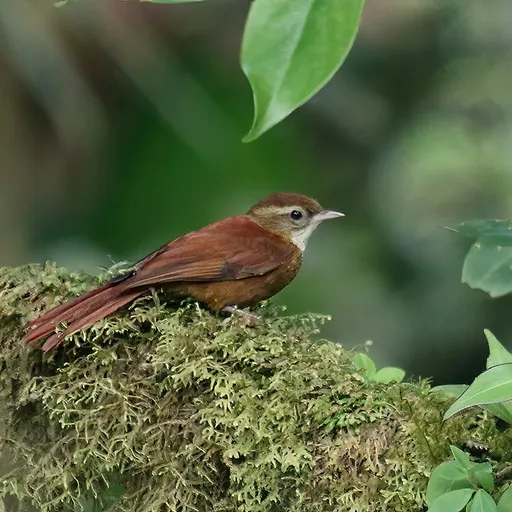
Ruddy Treerunner
Margarornis rubiginosus
Least Concern
Overview
The ruddy treerunner (Margarornis rubiginosus) is a passerine bird in the ovenbird family Furnariidae, found in the highlands of Costa Rica and Panama. It is a year-round resident and is currently assessed as being of Least Concern by the IUCN.
Identification
- Length of 15 to 16 cm with a weight of 17 to 24 g; sexes have the same plumage.
- Dull rufescent brown face featuring a buffy whitish supercilium and eyering, with a dull reddish brown crown and a narrow, paler reddish collar.
- Upperparts and wing coverts are reddish chestnut, while the tail is a slightly paler reddish chestnut with feather ends lacking barbs, giving a spiny appearance.
- Throat is whitish with a buffy white lower edge; breast is dull rufescent brown with pale buff 'Vees' on the upper part and darker buff spots on the lower.
- Legs and feet are variable, ranging from grayish olive to dull pinkish or grayish brown.
- Call is described as a thin, whistled 'tsit' usually in a rapid, irregular series, accompanied by metallic chirping notes and a descending trill.
Habitat
This species inhabits the interior and edges of montane evergreen forest at elevations between 1,200 and 3,000 m. It has a disjunct distribution, with the nominate subspecies found from the Cordillera de Guanacaste in northern Costa Rica south into Panama's Chiriquí Province, and the M. r. boultoni subspecies located in eastern Chiriquí and Veraguas Provinces.
Diet
The ruddy treerunner feeds on a wide variety of arthropods, typically foraging singly or in pairs, often within mixed-species feeding flocks. It acrobatically hitches up trunks and along limbs to glean prey from branches and epiphytes, frequently while hanging upside down.
Did you know?
The bird constructs an oval ball nest from moss, pieces of epiphyte, and ferns attached to a tree trunk, with the tubular entrance located at its base. Both parents are believed to incubate the eggs and care for the nestlings, although specific details regarding clutch size and incubation periods remain unknown.
Sources
- Wikipedia · CC BY-SA 4.0
- Wikidata · CC0 1.0