
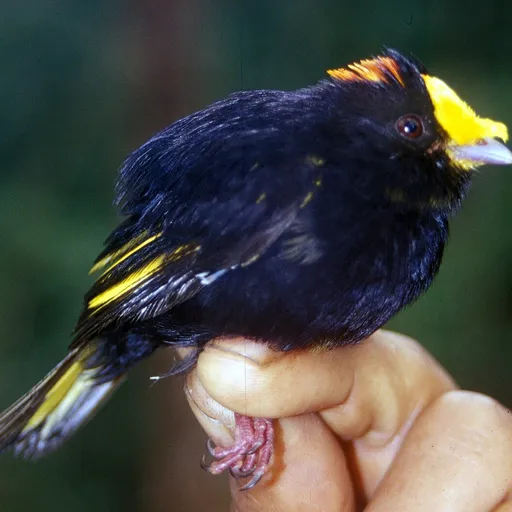
Golden-winged Manakin
Masius chrysopterus
Least Concern
Listen
XC248446 · Niels Krabbe · Pichincha: Río Pitsara and ridge 1 km NE Hda Francisco Rodríguez (=Asociación Calvas), Ecuador · CC BY-SA 4.0
Overview
The golden-winged manakin (Masius chrysopterus) is a small bird in the family Pipridae found across the Andean regions of South America. Classified as Least Concern by the IUCN, this species exhibits significant sexual dimorphism in plumage and behaviour, particularly during breeding displays.
Identification
- Size: Approximately 11 cm (4.3 in) in length, weighing between 9.0 and 13.5 g.
- Male plumage: Primarily black with a bright golden-yellow forecrown, orange-red hindcrown patch, golden-yellow throat, and entirely yellow wings and tail feathers.
- Female plumage: Mostly olive-green with a yellow-olive throat, belly, and wing linings, lacking the male's showy head features.
- Vocalisation: Males produce a quiet, frog-like "nurrt" call near display sites, while both sexes emit a thin, high-pitched "tseet" while foraging.
Habitat
Found in Colombia, Ecuador, Peru, and Venezuela, this species inhabits wet montane cloudforest, though it also forages in clearings and forest edges. It occupies elevations ranging from 600 to 2,400 m, with specific ranges varying by country and subspecies.
Diet
The golden-winged manakin feeds mostly on small fruits, with a preference for the Melastomataceae genus Miconia, and also consumes small insects. Foraging is typically done singly, using a technique of briefly hovering after a short sally from a perch, and the birds may associate loosely with mixed-species flocks.
Did you know?
Males perform complex courtship displays on mossy logs and buttress roots, involving bouncing and flashing their yellow wings, which highlights a potential vulnerability as reproductive behaviours may be negatively affected if available habitat consists only of young second-growth or heavily disturbed forest.
Sources
- Wikipedia · CC BY-SA 4.0
- Wikidata · CC0 1.0