
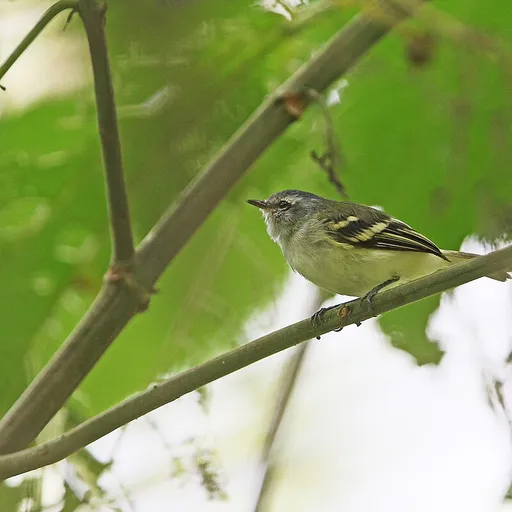
White-tailed Tyrannulet
Mecocerculus poecilocercus
Least Concern
Listen
XC248505 · Niels Krabbe · Pichincha: Tandayapa ridge 3 km SSW Tandayapa, Ecuador · CC BY-SA 4.0
Overview
The white-tailed tyrannulet is a small species of bird in the family Tyrannidae, the tyrant flycatchers. It is classified as monotypic and forms a superspecies with the buff-banded tyrannulet. The species is currently assessed by the IUCN as being of Least Concern.
Identification
- Approximately 11 cm in length and weighing 10 to 11 g, with medium gray legs and a thin, pointed black bill.
- Plumage features a medium gray crown, a thin white supercilium, and a faint blackish eye-stripe on a whitish face.
- Upperparts are greenish olive with a bright greenish yellow rump, while the tail has a mostly to fully white outermost pair of feathers.
- The dawn song is described as a high, lisping 'pseeee-psweet', transitioning to a descending series of sibilant whistles during the day.
Habitat
This bird inhabits humid montane evergreen forest in the subtropical zone, particularly mossy cloud forests, across the Andes of northern Colombia, Ecuador, and Peru. Its elevation range varies by country, occurring between 1,450 and 2,800 m depending on the location within its range.
Diet
Feeds primarily on insects, supplemented by small fruits, and usually forages in pairs or small groups, often joining mixed-species flocks. It gleans food from leaves, twigs, and tree-ferns while perched in the canopy, occasionally making short upward flights to hover.
Did you know?
The species exhibits a highly specific vocalisation pattern, with its dawn song described as a 'high, lisping pseeee-psweet' that shifts to a descending series of sibilant whistles during the day. Its population density varies significantly across its range, being considered uncommon in Colombia, 'numerous' in Ecuador, and fairly common in Peru.
Sources
- Wikipedia · CC BY-SA 4.0
- Wikidata · CC0 1.0