
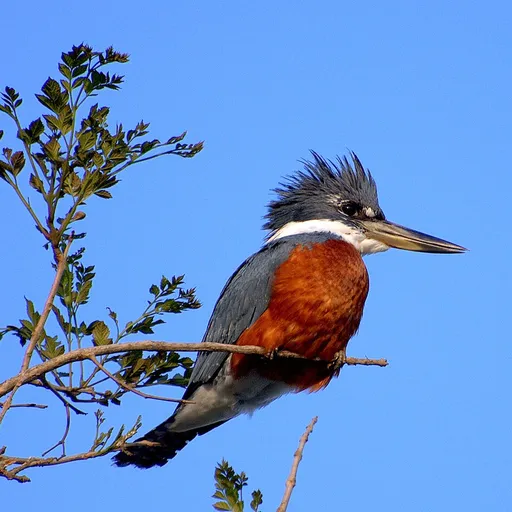
Ringed Kingfisher
Megaceryle torquata
Least Concern
Listen
XC251087 · Niels Krabbe · Pichincha: Río Guaycuyacu, Ecuador · CC BY-SA 4.0
Overview
The ringed kingfisher (Megaceryle torquata) is a large, conspicuous, and noisy kingfisher bird found across the Americas. It ranges from the lower Rio Grande Valley in southeasternmost Texas through Central America to Tierra del Fuego in South America.
Identification
- Large body size with a massive bill that is longer than the head and features curved culmens and tomial serrations.
- Plumage includes a blue back, a large crest between the bill and neck, and dark-brown irises; males have rusty-brown underparts with white undertail coverts and throats, while females display a bluish-gray band on the upper breast.
- Feet possess syndactyl structure with olive-green or yellowish toes and black claws.
- Vocalisations are described as rattles, with louder and lower-pitched calls than belted kingfishers, including klek or kek sounds.
Habitat
The species inhabits freshwater environments as well as tropical and temperate marine shorelines, including specific locations like Coiba Island. Breeding typically occurs in aquatic regions with high fish densities, such as streams, rivers, ponds, lakes, estuaries, and marine habitats, often preferring clear water with less vegetation. In the tropics, there is a notable preference for mangrove habitats.
Diet
The diet is largely dependent on fish, particularly species from the families Characidae and Cichlidae, though crabs and other crustaceans are also targeted. Foraging is performed by diving from a perch, often after watching for prey in fresh water for several hours. Individuals have been observed foraging in marine water and can forage offshore as far as 1 km.
Did you know?
Ringed kingfishers have strong wings that beat very slowly as a result of their large size, allowing them to fly over land for long periods in comparison to other kingfisher species. Their anatomy prevents efficient terrestrial movements, causing them to shuffle when entering and exiting nesting burrows.
Sources
- Wikipedia · CC BY-SA 4.0
- Wikidata · CC0 1.0