
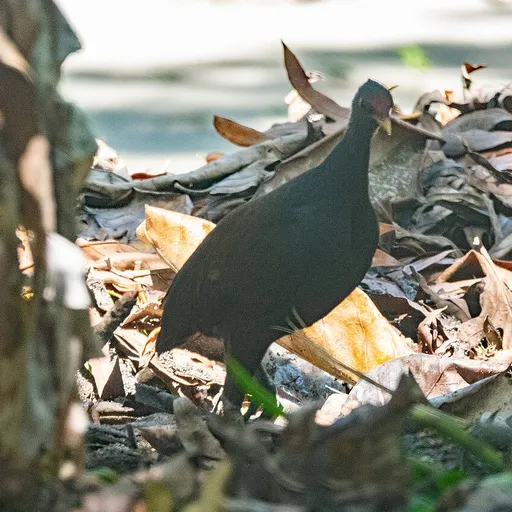
Melanesian Megapode
Megapodius eremita
Least Concern
Overview
The Melanesian scrubfowl, also known as the Melanesian megapode (Megapodius eremita), is an island-endemic megapode found in Melanesia. It is notable for its unique incubation strategy, relying on environmental heat sources such as geothermal energy or sun-warmed soil rather than parental body heat.
Identification
- Plumage: Adults feature a brown back, dark grey head, neck and underparts, with some variation where eastern populations are lighter and more red-brown.
- Size and Shape: Measures 34 to 39 cm with a stout body, short tail, and short head crest; legs are brown, grey, or olive-coloured.
- Markings: Distinctive red patches of bare skin on the face, notably the forehead, and a yellow bill-tip.
- Call: Males produce loud, territorial honking, wailing and grunting sounds lasting one to five seconds, such as kee-yah or ko--ko--ko.
- Song: The species performs a duet where one partner makes a laugh-like keyououourrr sound and the other replies with keyou keyourr.
Habitat
The species inhabits islands in the Bismarck Archipelago and Solomon Islands, preferring lowland rainforests with large trees, an open understorey, and deep soils. Breeding grounds vary by region and include sandy beaches warmed by the sun, geothermal sites near volcanoes, and soils containing decaying organic matter.
Diet
Omnivorous, feeding on fruits such as Ficus and Canarium indicum nuts, as well as small invertebrates including insects, snails, millipedes and earthworms. Birds forage alone, in pairs, or in small groups by scratching the forest floor with their large feet to search leaf litter, and occasionally jumping to pick low-hanging fruits.
Did you know?
The chicks are superprecocial, emerging from eggs that are up to 69% yolk content, which allows them to be fully capable of running, foraging and short-distance flying immediately upon hatching. They lack an egg tooth, using their strong legs instead to crack the shell and dig to the surface of the burrow.
Sources
- Wikipedia · CC BY-SA 4.0
- Wikidata · CC0 1.0