
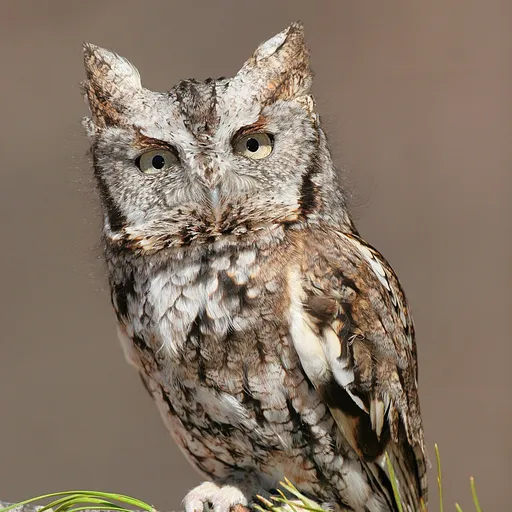
Eastern Screech Owl
Megascops asio
Least Concern
Listen
XC1058584 · nocoastkyle · Arvada, Jefferson County, Colorado, United States · CC0 1.0
Overview
The eastern screech owl (Megascops asio) is a stocky, short-tailed owl that is relatively common across eastern North America, ranging from Mexico to Canada. It is one of the heaviest screech owls and is notable for its adaptability to urban and developed environments, where it often lives in close proximity to humans.
Identification
- Size: Adults range from 16 to 25 cm (6½ to 10 in) in length with a wingspan of 46 to 61 cm (18 to 24 in).
- Plumage: Two main color morphs exist, gray and rusty (rufous), with the gray morph providing effective camouflage against hardwood bark and the red morph against pine or autumn leaves.
- Features: The species has a large, round head with prominent ear tufts, yellow eyes, and a yellowish beak; feet are typically feathered to the toes, except in southern populations.
- Voice: Although called a screech owl, it does not truly screech; its call is a tremolo with a descending, whinny-like quality resembling a miniature horse.
Habitat
The species occupies the greatest range of habitats of any owl east of the Rockies, including open mixed woodlands, deciduous forests, parklands, and urban yards. It tends to avoid areas with regular activity from larger owls, such as great horned owls, and its distribution largely follows eastern deciduous woodlands. In urban environments, it may roost in man-made locations such as behind loose boards on buildings, in boxcars, or on water tanks.
Diet
Eastern screech owls feed on a variety of prey, including meadow voles, which are a dietary favorite, as well as large insects such as cicadas and anole lizards. In urban settings, they often meet their dietary needs through introduced species like house sparrows and house mice. While the male provides most of the food to the female and young, the female primarily handles brooding.
Did you know?
Despite their name, these owls do not truly screech, instead producing a call that sounds like a tremolo with a descending, whinny-like quality similar to a miniature horse. They are also remarkably adaptable, having been recorded nesting on the top of a street light in the middle of a busy town square or along the border of a busy highway.
Sources
- Wikipedia · CC BY-SA 4.0
- Wikidata · CC0 1.0