
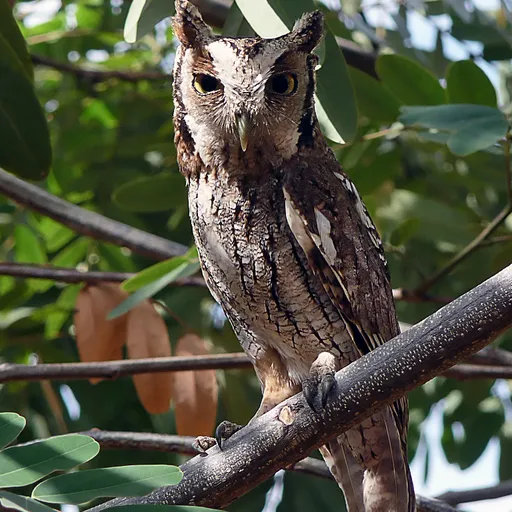
Tropical Screech Owl
Megascops choliba
Least Concern
Listen
XC1107341 · Rosa Elena Albornoz @rosaelena_naturaleza · Osma, La Guaira, Venezuela · CC0 1.0
Overview
The tropical screech owl (Megascops choliba) is a small, polymorphic owl species in the family Strigidae, recognised as the most common and widespread screech-owl of the neotropics. It is currently assessed as Least Concern by the IUCN Red List and remains common across a vast range in Central and South America.
Identification
- Overall gray-brown, brown, or rufous plumage with a distinctive blackish edge to the face.
- Yellow irides.
- Pale undersides featuring a black "herringbone" pattern.
- Length of 21 to 23 cm and a weight between 97 and 160 g.
- Primary song described as a short, purring trill followed by two accentuated clear notes.
Habitat
The species ranges from Costa Rica and Panama through South America, including Trinidad and Tobago, but is largely absent from the far south and the interior of forests. It prefers a wide variety of partially to mostly open landscapes, such as secondary forest, open woodland, coffee plantations, residential areas, and the borders of terra firme and várzea forests.
Diet
Being nocturnal, the tropical screech owl forages by sallying from a low perch to capture prey on the ground, from branches, or in the air. Its diet consists of large arthropods, such as scorpions, spiders, and insects, as well as small vertebrates including frogs, reptiles, other birds, bats, and rodents.
Did you know?
Adults defend their nests using "fluffing" displays and aggressive moves that may extend to striking humans with their claws. Deforestation may actually benefit the species, as it provides the open habitats it frequents.
Sources
- Wikipedia · CC BY-SA 4.0
- Wikidata · CC0 1.0