
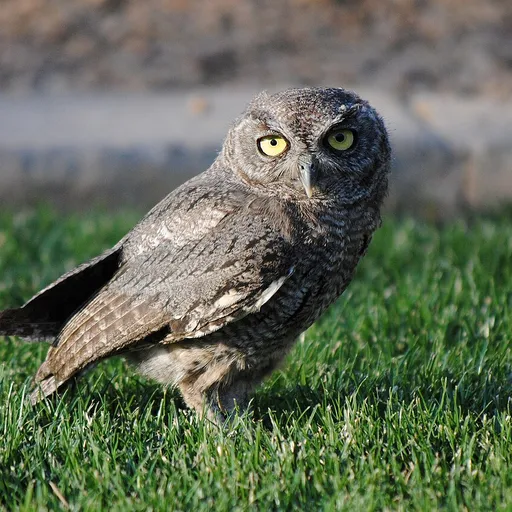
Western Screech Owl
Megascops kennicottii
Least Concern
Overview
The western screech owl (Megascops kennicottii) is a small owl native to North and Central America, closely related to the eastern screech owl. The species is considered of low conservation concern despite a slow decline in the Pacific Northwest, with a population estimated at 180,000 individuals.
Identification
- Length averages 22 cm (8.7 in) with a wingspan of 55 cm (22 in); females are larger than males, and northern populations are notably larger than southern ones.
- Plumage is brown or dark gray with streaking on the underparts, featuring several morphs including brown Pacific, grey Pacific, Great Plains, Mojave, and Mexican, but no red morph.
- Physical features include a round head with ear tufts, yellow eyes, and a yellowish bill, though they resemble whiskered and eastern screech owls and are best identified by their calls.
- The primary call consists of an accelerating series of short whistles at an increasing tempo or a short then long trill that falls slightly at the end, with male songs generally lower in frequency than those of females.
Habitat
The western screech owl is native to Canada, the United States, Mexico, Guatemala, El Salvador, Honduras, Costa Rica, and Nicaragua. It inhabits a wide range of environments, including temperate, subtropical, and tropical montane forests, shrubland, desert, rural fields, and even suburban parks and gardens.
Diet
These nocturnal birds forage by waiting on perches to swoop down on prey or catching insects in flight, relying on excellent hearing and night vision. Their diet mainly consists of small mammals such as mice, rats, flying squirrels, and bats, as well as birds and large insects like cicadas. They are opportunistic predators that also consume small trout, annelid worms, scorpions, crayfish, reptiles, amphibians, and occasionally larger animals like mallard ducks or cottontail rabbits.
Did you know?
Western screech owls do not build traditional nests but instead reside in cavities in trees, banks, or cliffs, often using spaces originally created by woodpeckers or natural causes. Males actively court females by bringing them food and producing a series of clicking noises before the pair preens each other and sings duets.
Sources
- Wikipedia · CC BY-SA 4.0
- Wikidata · CC0 1.0