
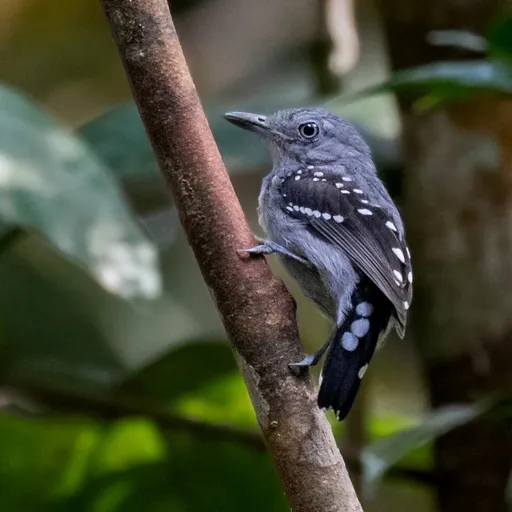
Pearly Antshrike
Megastictus margaritatus
Least Concern
Overview
The pearly antshrike (Megastictus margaritatus) is a species of bird in the family Thamnophilidae, known as the typical antbirds. It is the sole member of the genus Megastictus and is classified as Least Concern by the IUCN, although its population is believed to be decreasing.
Identification
- Adult males possess a gray face, crown, and upperparts with wings that are black and feature large round white spots, while the tail is black with white feather tips.
- Adult females display a yellowish brown face, crown, and upperparts with pale buffish spots on the wings and tail, contrasting with the male's white markings.
- The species is small, measuring 12 to 13 cm in length and weighing between 18 and 21 g.
- Its song consists of 2–3 slowly delivered whistles slurred up and down, followed by 6–7 flat raspy notes delivered at a faster pace.
Habitat
Found in Brazil, Colombia, Ecuador, Peru, and Venezuela, the pearly antshrike inhabits the understorey of evergreen forests and nearby secondary woodlands. It favours terra firme and forest on sandy soils in Ecuador and reaches elevations up to 1,200 m in Brazil, though it typically occurs at lower altitudes in other regions.
Diet
The diet includes insects and other arthropods, which the bird captures by sallying from a perch to grab prey from foliage, stems, and vines, or by hover-gleaning. Foraging usually occurs singly, in pairs, or in family groups between 2 and 6 m above the ground, though heights can range from 1 m to 10 m.
Did you know?
The male pearly antshrike was observed incubating eggs during the day, a behaviour that contrasts with the typical nocturnal incubation often associated with the male role in many bird species.
Sources
- Wikipedia · CC BY-SA 4.0
- Wikidata · CC0 1.0