
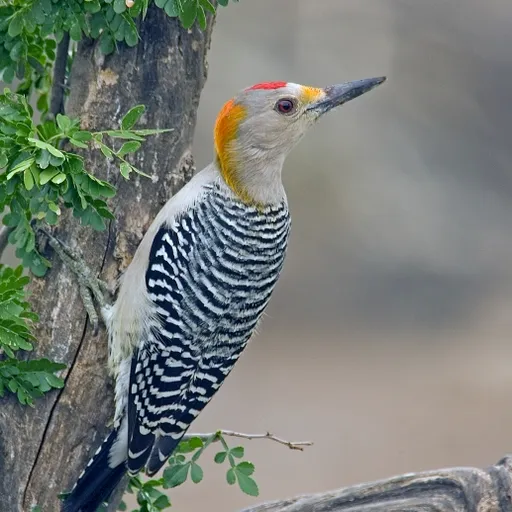
Golden-fronted Woodpecker
Melanerpes aurifrons
Least Concern
Overview
The golden-fronted woodpecker (Melanerpes aurifrons) is a species in the subfamily Picinae of the woodpecker family Picidae. It is found in the southern United States, mostly Texas, as well as Mexico and parts of Central America.
Identification
- Adults measure 22 to 26 cm (8.7 to 10 in) in length.
- Males have a red crown and a golden orange to yellow nape with a gap between them, whereas females have a grayish crown and a paler yellow nape.
- Upperparts are mostly barred black and white with white uppertail coverts that have a few black spots.
- Underparts are smoke gray to drab gray with light blackish bars on the flanks and undertail coverts, and a yellow patch on the belly.
- Legs and feet are grayish green to greenish gray.
Habitat
The species ranges from southwestern Oklahoma through central Texas onto the Mexican Plateau as far as Jalisco, San Luis Potosí, and Hidalgo, with casual records in New Mexico, East Texas, Michigan, and Florida. It inhabits both mesic and xeric landscapes, favouring mesquite brushlands and riparian woodlands, and also frequents urban parks and suburban areas.
Diet
Its diet consists of adult and larval arthropods, some aerial insects, much fruit and nuts, and corn, with occasional predation of other birds' eggs. The bird forages mainly in trees, especially on major limbs and typically below 6 m (20 ft), but also on open or grassy ground. It takes its food by gleaning, pecking, probing, and least frequently by aerial flycatching.
Did you know?
Although it typically excavates nest cavities in tree trunks or limbs, it has been observed using utility poles, fence posts, and nest boxes for breeding.
Sources
- Wikipedia · CC BY-SA 4.0
- Wikidata · CC0 1.0