
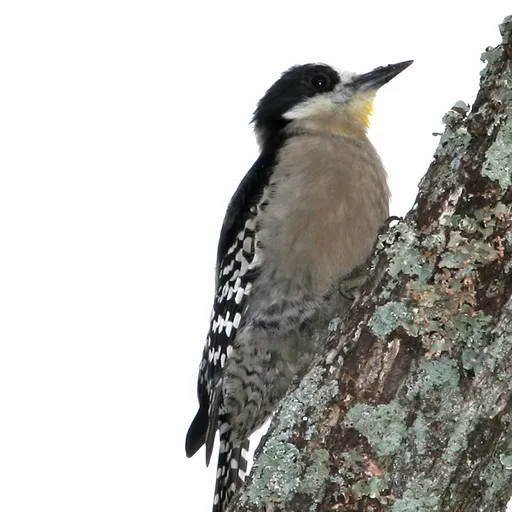
White-fronted Woodpecker
Melanerpes cactorum
Least Concern
Overview
The white-fronted woodpecker (Melanerpes cactorum) is a species of bird in the family Picidae found mainly in central South America. It is a sedentary, non-migratory species that is classified as Least Concern on the IUCN Red List due to its extensive range and stable population.
Identification
- Approximately 17 cm in length with a greyish-black beak and grey legs.
- Glossy black crown, nape, and upper parts, featuring a thin white line running down the centre of the back from a white nape patch.
- White fore-crown and cheeks, with a white, yellow, or buff chin and throat; breast and belly are grey with indistinct barring on the flanks.
- Wings are bluish-black barred with white on the upper side and browner underneath; males possess a small, often hidden patch of red on the crown.
Habitat
Native to central South America, including southeastern Peru, Bolivia, Uruguay, northern Argentina, Paraguay, and southeastern Brazil. It inhabits subtropical or tropical dry forests, shrublands, savannahs, and semi-deserts with scattered trees, shrubs, and cacti, as well as palm groves, gallery forests, and agricultural land. It resides at altitudes up to 2,500 m and is a non-migratory, sedentary species.
Did you know?
While the sexes are similar in appearance, males possess a small patch of red on the crown that is not always visible, whereas both juvenile males and females exhibit traces of red or orange on the mid-crown.
Sources
- Wikipedia · CC BY-SA 4.0
- Wikidata · CC0 1.0