
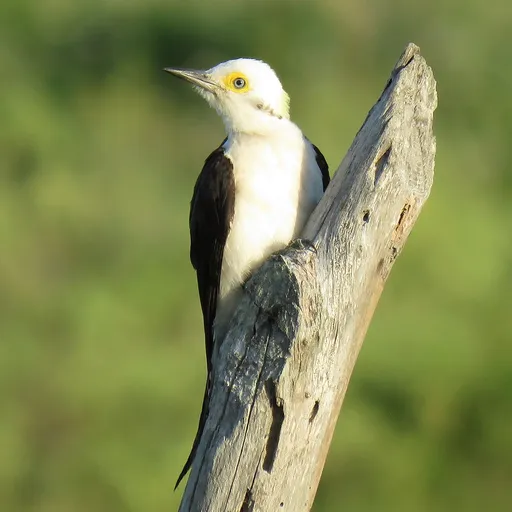
White Woodpecker
Melanerpes candidus
Least Concern
Overview
The white woodpecker (Melanerpes candidus) is a South American species of woodpecker native to the wooded grasslands of Suriname, French Guiana, Brazil, Bolivia, Paraguay, Uruguay and Argentina. It is a bright white bird with black wings and is classified as a least-concern species by the IUCN.
Identification
- Adults measure 24 to 29 cm in length, featuring a bright white crown, face, rump and underparts contrasted with a black mantle, back, wings and tail.
- A distinctive small bright yellow eye patch surrounds the eye, which has a yellowish iris.
- A narrow black stripe runs from behind the eye to the nape, and the beak is long and grey.
- Males show yellowing of the breast and nape, while females lack this feature but both have some yellow on the belly.
Habitat
Found across South America east of the Andes, the species occupies forest edges, open dry woodland, wooded savannah, scrubland with scattered trees, plantations, orchards, parkland and mangroves. It is non-migratory but makes short-distance movements, and is opportunistic enough to be seen in city suburbs and expanding into areas of felled timber.
Diet
The diet is varied, including fruits, berries and seeds, with the bird acting as a significant disperser of some seed species. It forages in noisy family groups and also raids wild bee and wasp nests to feed on adult insects, larvae and honey.
Did you know?
Groups of up to ten white woodpeckers are sometimes seen flying with floppy wing-beats in procession. Although breeding habits are poorly understood, the species may sometimes nest communally.
Sources
- Wikipedia · CC BY-SA 4.0
- Wikidata · CC0 1.0