
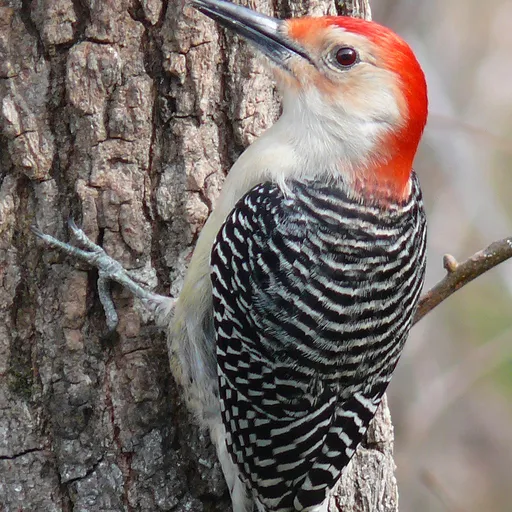
Red-bellied Woodpecker
Melanerpes carolinus
Least Concern
Listen
XC871896 · steve · Chapel Hill, Orange County, North Carolina, United States · CC BY-SA 4.0
Overview
The red-bellied woodpecker (Melanerpes carolinus) is a medium-sized woodpecker found primarily in the eastern United States, ranging from Canada to Florida. It is classified as Least Concern on the IUCN Red List but depends heavily on the presence of large trees and snags for nesting and foraging.
Identification
- Mainly light grey face and underparts with black and white barred patterns on the back, wings, and tail.
- Adult males possess a red cap extending from the bill to the nape, while females have a red patch on the nape and another above the bill.
- A pale reddish tint on the lower underside gives the species its name, though this is difficult to observe in the field; white patches on the wings become visible in flight.
- Noisy birds producing varied calls described as 'churr-churr' or 'thrraa', along with drumming patterns of approximately six taps on hollow trees, aluminum roofs, or transformer boxes.
Habitat
Breeding habitat typically consists of deciduous forests, and the species relies on dead or decaying trees, known as snags, for nesting and roosting. While generally absent from extensively deforested areas, they may occasionally utilize gardens in such regions.
Diet
Omnivorous foragers that search for arthropods on tree trunks using their bill as a chisel and a long tongue to extract insects from cracks. They also consume fruits, nuts, and seeds, and are known to hide food items like berries and acorns in natural crevices for later consumption.
Did you know?
By excavating cavities in trees for their own nesting, these woodpeckers create shelters that are subsequently used by other species, such as squirrels and bats, playing a vital role in forest communities. Additionally, the species is a major predator of the invasive emerald ash borer in the U.S. Midwest, capable of removing up to 85 percent of borer larvae in a single infested ash tree.
Sources
- Wikipedia · CC BY-SA 4.0
- Wikidata · CC0 1.0