
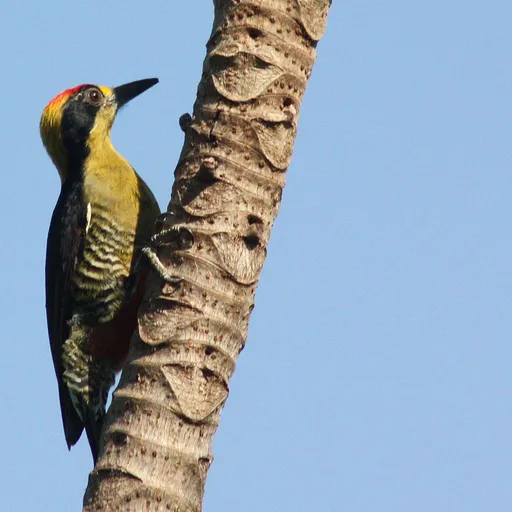
Golden-naped Woodpecker
Melanerpes chrysauchen
Least Concern
Overview
The golden-naped woodpecker (Melanerpes chrysauchen) is a Central American bird in the woodpecker family Picidae, very closely related to the beautiful woodpecker. It is a non-migratory species that is classified as of least concern by the International Union for Conservation of Nature.
Identification
- Measures about 18 cm (7 in) in length with a greyish-black beak and greyish-olive legs.
- Features a yellow nape and a black mask surrounding the eyes and running to the nape, with a small white patch behind the eye.
- Males display a red central-crown and yellow fore-crown, while females have an all-yellow crown interrupted by a narrow central transverse black band.
- The back and rump are mainly white, sometimes blotched with black, and the lower breast, belly, and flanks are barred in black and white with a red patch on the mid-belly.
Habitat
Endemic to the Pacific slopes of southwestern Costa Rica and western Panama, ranging in altitude from sea level to approximately 1,500 m (5,000 ft). It inhabits subtropical or tropical moist lowland forests, primary humid rainforest, woodland edges, secondary forests, plantations, and heavily degraded former forests.
Diet
The diet consists largely of fruit, including dates, bananas, figs, and Cecropia fruits. It also forages on tree trunks for insects such as beetle larvae and, particularly at dusk, sallies high into the air to catch winged termites and other flying insects.
Did you know?
Although restricted to a specific region, the bird is common within its range, with an estimated total area of occupation of 23,800 km2 (9,200 mi2). Its nesting period occurs between March and June, and it may occasionally produce two broods in a single season.
Sources
- Wikipedia · CC BY-SA 4.0
- Wikidata · CC0 1.0