
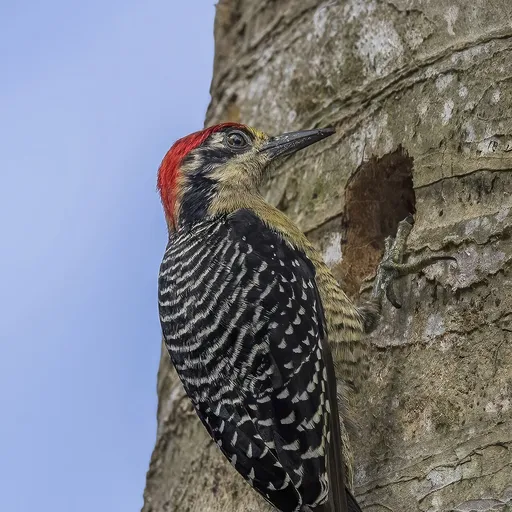
Black-cheeked Woodpecker
Melanerpes pucherani
Least Concern
Listen
XC251103 · Niels Krabbe · Esmeraldas: Canandé Botrosa Road end, Ecuador · CC BY-SA 4.0
Overview
The black-cheeked woodpecker (Melanerpes pucherani) is a species of bird in the woodpecker family Picidae. It is found from Mexico south to Ecuador and is currently assessed as a species of Least Concern by the IUCN.
Identification
- Males possess a golden yellow forehead and a red crown and nape, while females have a white to buffy white forehead, a black central crown, and a red hindcrown and nape.
- Both sexes feature black around the eye extending down the side of the neck, accompanied by a white line behind the eye.
- The underparts are buffish white with strong wavy bars and a red spot in the center of the belly, while the back has black and white bars.
- The call consists of a series of approximately four short rattling trills on the same pitch, sounding like 'churrr, churrr, churrr, churrr' or 'cherrr'.
Habitat
This species inhabits the interior and edges of humid to wet evergreen forest, mature secondary forest, abandoned plantations, and clearings with scattered trees, occasionally entering gardens far from forest. It is found from Veracruz and Chiapas in southern Mexico south on the Caribbean slope into Costa Rica, and on both slopes in Panama through western Colombia and western Ecuador slightly into Peru. Its elevation range is mostly between 700 and 900 m, though it occasionally reaches up to 1,200 m and locally as high as 1,500 m in Ecuador.
Diet
The black-cheeked woodpecker feeds on a wide variety of arthropods, including spiders, beetles, ants, and aerial insects, as well as plant material such as fruits, berries, seeds, and catkins. It forages singly or in pairs, probing, pecking, gleaning, and hawking from the midlevel to the crown of the forest, and sometimes joins mixed-species flocks.
Did you know?
The bird is named after the French zoologist Jacques Pucheran, who is commemorated in its specific epithet.
Sources
- Wikipedia · CC BY-SA 4.0
- Wikidata · CC0 1.0