
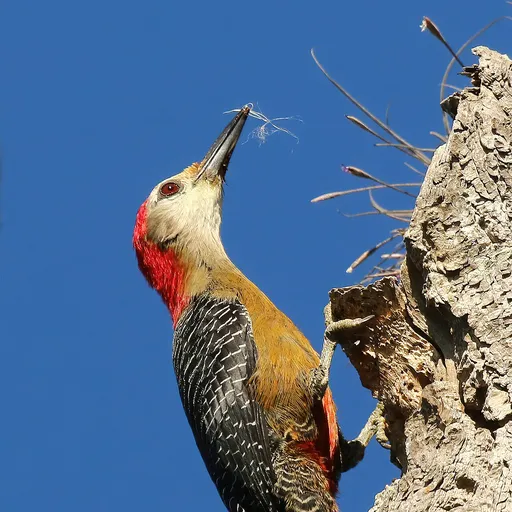
Jamaican Woodpecker
Melanerpes radiolatus
Least Concern
Overview
The Jamaican woodpecker (Melanerpes radiolatus) is a species of bird in the family Picidae, endemic to the island of Jamaica. It is considered a year-round resident throughout its range and is currently assessed as being of Least Concern, although its population is believed to be decreasing.
Identification
- Adults measure between 24 and 26 cm in length and weigh between 92 and 131 g. Males have a red forecrown extending to the hindneck, while females have a gray crown with red restricted to the hindcrown and hindneck.
- Upperparts are black with thin white bars, sometimes showing a greenish tinge, which are widest on the rump and uppertail coverts. Underparts are mostly olive-gray to olive-buff, with yellowish to reddish tones on the central belly.
- The bill is long and black, the iris is red, and the legs are slaty black. Lores are yellowish, and the cheeks, chin, and throat are white.
- The most common vocalization is a loud 'kaaa', often repeated two or three times, while both sexes drum loudly and tap softly near nest holes.
Habitat
Found throughout the island nation of Jamaica, the species inhabits a variety of wooded landscapes ranging from sea level to the highest mountains. It occurs in lower montane rainforest, wet and misty forests, mangroves, wooded pastures, citrus and coconut plantations, and gardens, reaching its highest density in mesophytic secondary forest.
Diet
The diet consists of approximately half animal and half vegetable matter, with animal prey mostly consisting of insects, snails, and occasionally lizards. Vegetable food is primarily fruits, especially those of Cecropia and Ficus. It typically forages near the forest crown but also hunts lower and in the canopy, collecting food by snatching fruit and using techniques such as probing, pecking, gleaning, and hawking.
Did you know?
Males perform most of the excavation for the nest hole, which is usually located between 5 and 15 m above the ground in a dead branch, dead trunk, or even a utility pole.
Sources
- Wikipedia · CC BY-SA 4.0
- Wikidata · CC0 1.0