
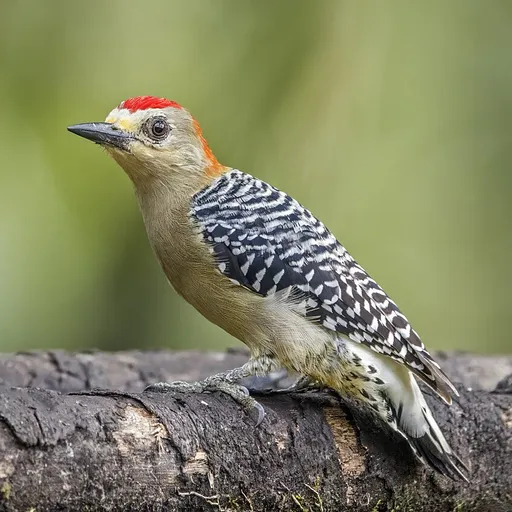
Red-crowned Woodpecker
Melanerpes rubricapillus
Least Concern
Overview
The red-crowned woodpecker (Melanerpes rubricapillus) is a species of bird in the subfamily Picinae of the woodpecker family Picidae. It is classified as Least Concern by the IUCN, with a large range and a stable population of at least half a million mature individuals.
Identification
- Adults measure 16 to 18.5 cm in length and weigh 40 to 65 g, with a longish, blackish bill and gray legs.
- Adult males feature a pale yellow to whitish forehead, a bright red crown, and an orange-red nape and hindneck, whereas females have a pale gray-buff to whitish crown.
- Both sexes have grayish-buff cheeks, chin, and throat, black-and-white barred mantles and backs, and unbarred white rumps; the underparts are typically buffish-gray with a reddish to orange-red belly patch.
- The typical call is described as wavering and protracted, such as 'churr, churr, krr-r-r-r', and the bird produces 'wícka, wícka' calls during display.
Habitat
Found in Costa Rica, Panama, Colombia, Venezuela, Guyana, Suriname, and Tobago, the species inhabits a wide variety of wet and dry landscapes, including mature deciduous and secondary forests, coastal scrublands, mangroves, plantations, and gardens. It typically occurs between sea level and 1,700 m, though it reaches up to 1,900 m in Venezuela.
Diet
The diet consists largely of fruits and berries, including cultivated varieties such as papayas and bananas, alongside insects, spiders, and nectar. Foraging occurs at all habitat levels but favors the middle and lower strata, involving probing, gleaning, and hammering for insects as well as piercing or pecking open larger fruits.
Did you know?
This woodpecker is considered a local nuisance in plantations and gardens due to its habit of eating fruits, yet it may actually benefit from forest clearance, with numbers tending to increase in areas where thinning and clearance create more open woodland.
Sources
- Wikipedia · CC BY-SA 4.0
- Wikidata · CC0 1.0