
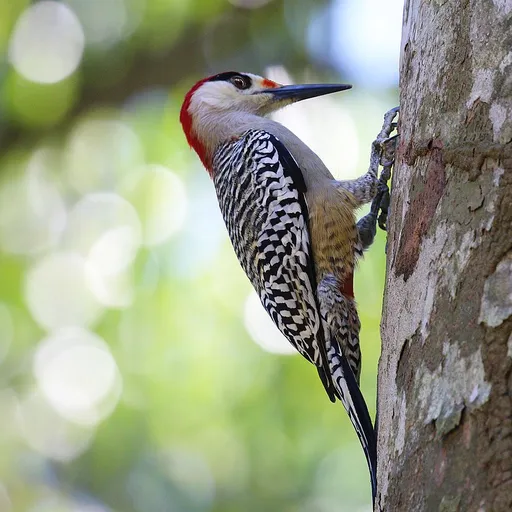
West Indian Woodpecker
Melanerpes superciliaris
Least Concern
Overview
The West Indian woodpecker (Melanerpes superciliaris) is a species of bird in the family Picidae, found across the Bahamas, the Cayman Islands, and Cuba. Currently assessed as Least Concern by the IUCN, the species is generally resilient to hurricanes but faces threats from increasing storm intensity and habitat loss on some small islands.
Identification
- Adults measure 27 to 32 cm in length and display barred black and buff or yellowish-white upperparts with white uppertail coverts.
- Males possess a red crown, nape, and hindneck, while females have a whitish or red crown with some black feathers, distinguished by a black supercilium.
- The underparts are greyish with a buffy brown to pale yellow-olive tinge on the breast, white flanks with black bars, and a distinctive red to orange-red patch on the belly.
- Features include a black bill, olive legs, and red to reddish-brown irises, with juveniles appearing duller and having a less distinct red belly patch.
Habitat
This species inhabits varied wooded landscapes, with preferences depending on the subspecies; for instance, Cuban populations favour areas with abundant royal palms, while Grand Cayman populations are common in forest on limestone areas with sparse vegetation. It typically ranges from sea level up to 1,000 m in elevation and acts as a year-round resident in its respective territories.
Diet
The bird feeds on arthropods such as insects and spiders, small vertebrates like frogs and lizards, as well as seeds and fruit. It forages on the ground and throughout the vegetation by gleaning, pecking, and probing.
Did you know?
While the species is generally monogamous, there is a record of a female laying eggs fathered by different males at two separate nests. Both sexes participate in excavating nest holes, which are typically located in dead palms or trees but have also been found in utility poles.
Sources
- Wikipedia · CC BY-SA 4.0
- Wikidata · CC0 1.0