
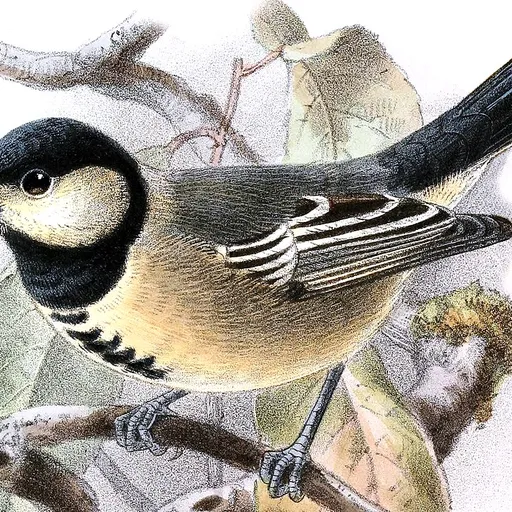
Acacia Tit
Melaniparus thruppi
Least Concern
Overview
The acacia tit, also known as the Somali tit or northern grey tit, is a small bird in the family Paridae native to north-eastern Africa. It occurs primarily in dry acacia habitats and is currently classified as Least Concern on the IUCN Red List.
Identification
- Glossy blue-black cap, nape, throat, and breast contrasting with a large buffy white patch extending from the bill to the sides of the neck.
- A broad black band stretches from the breast to the vent, which tends to be narrower in females than in males.
- Grey upperparts featuring white panels in the wings and a white spot on the nape, with slate-grey legs and bill.
- Measures 11.5–12 cm in length and weighs approximately 12 g, making it the smallest of the African grey Melaniparus tits.
Habitat
Found from Ethiopia and Somalia south to north-eastern Tanzania, the species inhabits arid and semi-arid wooded and bushed savanna. It principally occupies acacia woodland and stands of trees along streams or rivers, avoiding truly arid regions, and has been recorded up to 2,000 m in elevation in Somalia.
Diet
The acacia tit forages for small invertebrates, principally consuming wasps, beetles, and caterpillars. It is typically found in pairs or small parties, though it occasionally joins mixed-species foraging flocks.
Did you know?
One observed nest was found to have been predated by a snake, yet otherwise the habits and ecology of this species remain poorly known.
Sources
- Wikipedia · CC BY-SA 4.0
- Wikidata · CC0 1.0