
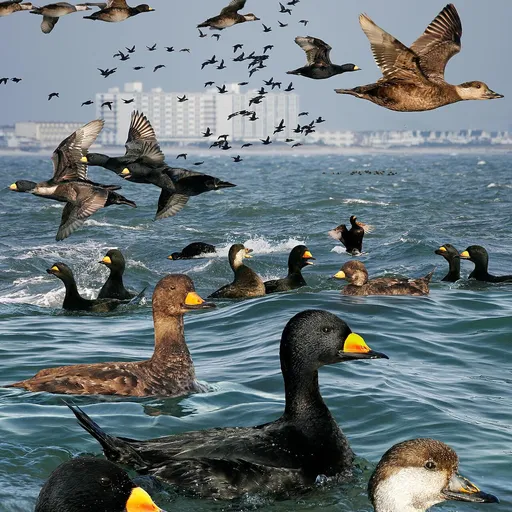
Black Scoter
Melanitta americana
Near Threatened
Overview
The black scoter, or American scoter (Melanitta americana), is a large sea duck that is listed as Near Threatened by the IUCN. It forms a subgroup with the common scoter and is occasionally considered part of the same species.
Identification
- Adult males are entirely black with a very bulbous bill that is mostly yellow, featuring no white markings.
- Females are brown with pale cheeks, though they resemble female common scoters.
- Males are larger and heavier than females, reaching up to 49 cm in length and 1,100 g in weight.
- Males perform a diagnostic downward head movement when stretching their wings.
Habitat
This species breeds in the far north of North America, including Labrador, Newfoundland, and areas northwest of Hudson Bay, as well as parts of Siberia. During winter, it migrates to temperate coastal waters in the northern United States and Canada, the Pacific coast down to San Francisco Bay, and as far south as China in Asia. It occasionally over-winters on the Great Lakes and is a very rare vagrant to western Europe.
Diet
While migrating or wintering on sea coasts, black scoters dive to feed on crustaceans and molluscs. In freshwater nesting areas, they consume insects and larvae, particularly caddisflies, fish eggs, and occasionally vegetation like duckweed.
Did you know?
Each egg laid by a female black scoter weighs 8% of her total body weight. The species nests later than most other ducks in North America, with pairs forming in late winter or spring.
Sources
- Wikipedia · CC BY-SA 4.0
- Wikidata · CC0 1.0