
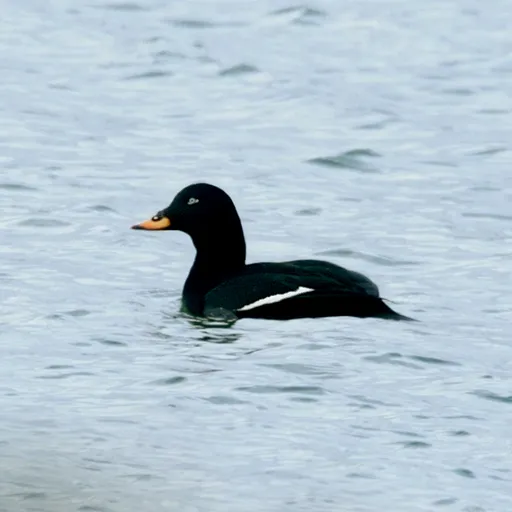
Velvet Scoter
Melanitta fusca
Vulnerable
Overview
The velvet scoter, Melanitta fusca, is a large sea duck that breeds across the far north of Europe and the Palearctic west of the Yenisey basin. It is currently classified as a Vulnerable species on the IUCN Red List.
Identification
- A relatively large sea duck measuring 51–56 cm in length with a wingspan of 90–99 cm.
- Characterised by a thick neck, a long broad bill, and a pointed tail.
- Males feature glossy black plumage with large white wing patches and small white patches behind the eye, along with a partly orange bill.
- Femiles are similar to males but lack the glossy sheen, appearing duller and browner.
Habitat
Breeding occurs in northern Europe from Norway to the Yenisey River in central Siberia and northeast Kazakhstan, with wintering grounds extending into temperate zones such as Great Britain and the Black and Caspian Seas. The species forms large, tightly packed flocks on suitable coastal waters and occasionally reaches as far south as France and northern Spain.
Diet
This duck forages by diving to capture crustaceans and molluscs.
Did you know?
The genus name Melanitta combines the Ancient Greek melas meaning 'black' with netta meaning 'duck', while the species name fuscus is derived from Latin for 'dusky', 'black', or 'brown'.
Sources
- Wikipedia · CC BY-SA 4.0
- Wikidata · CC0 1.0