
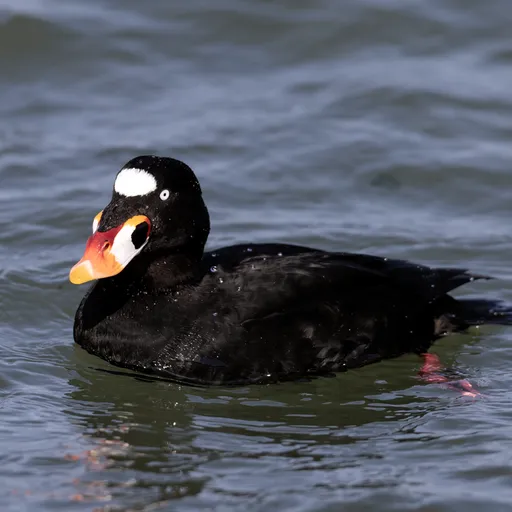
Surf Scoter
Melanitta perspicillata
Least Concern
Overview
The surf scoter (Melanitta perspicillata) is a large sea duck native to North America and the smallest species of scoter on average. It breeds in Northern Canada and Alaska before migrating to the Pacific and Atlantic coasts of North America for the winter.
Identification
- Adult males are velvety black with distinctive white patches on the forehead and nape, while females are browner with a more uniform plumage.
- Males possess a swollen bill that appears orange at a distance but is patterned with white, red, and yellow, featuring a black spot near the base.
- Females and immatures are distinguished from other scoters by a bulkier bill with a squarish base and a more flattened head profile.
- In flight, the surf scoter is the only scoter with completely dark wings, distinguishing it from similar species.
Habitat
This migratory species breeds in boreal forests near northern freshwater lakes, typically close to spruce cover, and winters in marine habitats near the shore. It primarily breeds in Northern Canada and Alaska, wintering along the Pacific and Atlantic coasts of North America, with the Pacific coast hosting the highest numbers over a range extending from the Aleutian Islands to the Baja Peninsula.
Diet
Surf scoters mainly feed on benthic invertebrates, consuming smaller prey such as mussels, crustaceans, and herring spawn, which they capture underwater and consume whole. During the breeding period, they forage on freshwater invertebrates, while for the rest of the year they feed on marine organisms in flocks ranging from a few individuals to several thousands. They exhibit opportunistic behaviour, shifting their diet based on the relative profitability of food, such as feeding on epifaunal crustaceans in seagrass beds or Pacific herring eggs during spawning.
Did you know?
Despite having a global population estimated between 250,000 and 1,300,000 individuals, the species has experienced a 50–70% decline over the past 40 years. A single oil spill in San Francisco harbour in November 2007 killed thousands of birds, with approximately 40% of the affected birds being surf scoters.
Sources
- Wikipedia · CC BY-SA 4.0
- Wikidata · CC0 1.0